
AR in Submarine Manufacturing
The measurement and quality control of components is a time-consuming process, especially in submarine manufacturing. Hololight shows how augmented reality can support this work in one of the most demanding industrial settings in the world.
Thyssenkrupp Marine Systems: AR for Precision Assembly
Positioning thousands of components with millimetre precision inside a submarine — without paper plans or manual marking. Thyssenkrupp Marine Systems used Hololight Space to digitalize component positioning and quality control in one of the most complex manufacturing environments in the world.
- Organization: Thyssenkrupp Marine Systems
- Challenge: Positioning and verifying thousands of components during submarine assembly using error-prone, paper-based 2D processes.
- Solution: Hololight Space, used on-site to overlay virtual 3D models onto the real environment for guided assembly and target/actual comparison.
- Result: Shorter assembly process, fewer manual errors, and measurably more economical planning and installation.
August 4, 1906: The first German submarine slides into the water at the Krupp Germaniawerft shipyard in Kiel. For more than a year, engineers and workers feverishly built the prototype. Today, thyssenkrupp Marine Systems is manufacturing submarines and naval ships on parts of the old site – and aims to become one of the most avant-garde shipyards in Europe. This goes hand in hand with applying new technologies such as augmented reality to make production more effective, efficient and faster.
“With Augmented Reality we are able to quickly detect and correct manual errors. The entire planning and assembly process is now much shorter and way more economical.”
– Stefan Lengowski, Manager Development Engineering Platform, thyssenkrupp Marine Systems
From Paper to Augmented Reality
The construction of submarines is complex and accompanied by extremely high technical requirements. Several thousand components have to be aligned, welded in and inspected. Surveyors determine the position and alignment of bolts and screws using analogue 2D documents. This means that they draw the data from the CAD model on paper plans and then – equipped with the clipboard – manually mark the locations in the submarine. A time-consuming and error-prone process.
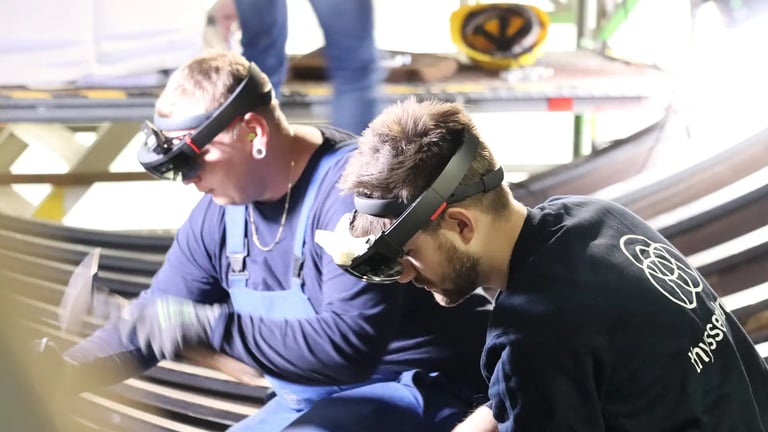
The inner life of a submarine is a complex ecosystem in itself. Augmented Reality helps engineers to greatly improve and simplify the design – so that every bolt goes where it belongs. (CR: thyssenkrupp Marine Systems)
“We are always looking for innovative technologies to optimize our processes. We see augmented reality as a technology for digitizing the time-consuming measurement and quality control of components,” says Stefan Lengowski. “But we are also aware that we are facing a very challenging use case scenario.”
Comprehensive AR Solution
Hololight Space enables engineers to visualize, manipulate and share CAD data in 3D, overlaid directly onto the real environment through an AR headset. The software supports millimetre-precise positioning work, allowing engineers to define, place and verify coordinates for components such as screws and bolts directly in the physical environment — without paper plans or manual marking.
For the deployment at thyssenkrupp Marine Systems, Hololight Space was used in combination with an industry-certified AR headset suited for safety-regulated environments on the shipyard floor.

Hololight's AR solution impresses with its millimetre accuracy and is a useful tool for quality control and measurement.
Optimizing Processes and Avoiding Errors
The new work process is now significantly shorter and easier for the engineers. In the office, the engineer can load the 3D model — for example in JT format — in the software, define the coordinates for referencing screws and bolts and upload them to the AR headset. Virtual components provide markings and include visual feedback on the correct placement.
In the submarine itself, the engineer uses Hololight Space to precisely mark the locations where a screw is to be mounted by superimposing virtual 3D models onto the real environment. Subsequently, the assembly takes place and the engineer can carry out a target/actual comparison in the submarine using the AR headset and software. "With Augmented Reality, we are able to quickly detect and correct manual errors. The entire planning and assembly process is now much shorter and way more economical," confirms Lengowski.
Where This Started — and Where AR in Manufacturing Stands Today
Especially for complex assembly projects such as submarines, AR improves planning and installation processes that were previously costly and error-prone. The resources required are lower, planning errors are noticed more quickly, and installation errors are hardly possible. As a result, costs and time can be massively reduced, while at the same time quality and speed are increased.
What began as one of the first deployments of AR in submarine manufacturing has since proven the concept at scale. Thyssenkrupp Marine Systems has continued to expand AR across their operations — from shipbuilding and pipe construction through to commissioning and training. The use case demonstrated here, replacing paper-based component positioning with AR-guided precision assembly, remains one of the clearest examples of what AR delivers in complex, safety-critical manufacturing environments.