
Factory Planning with Augmented Reality
BASF, the world’s largest chemical company, visualizes CAD models as holograms for on-site validation, in a running plant.
BASF: AR for Chemical Plant Planning and Expansion
Planning new equipment, pipelines and assemblies inside running chemical production facilities demands engineering precision — and leaves little room for error. BASF engineers use Hololight's 3D viewer to validate CAD data directly on-site, inside operational plants, before anything is built.
- Organization: BASF
- Challenge: Planning complex plant infrastructure inside running production facilities, without stopping operations or relying on 2D screens.
- Solution: Hololight Space, used on-site to visualize and validate CAD data as holograms in the real factory environment.
- Result: Fewer planning errors, faster decision-making, and real-time documentation of changes — directly in the field.
The planning of a complete production line or individual plant expansion has a significant influence on investment and operating costs. The challenge at BASF is not just the complexity of the planning itself — it is that planning must happen inside facilities that cannot be paused. New pipelines, machines and assemblies need to be integrated into existing, operational environments. Data in the system becomes obsolete. Design faults make complex construction projects more difficult. Incorrect planning causes costs to skyrocket. Teams of engineers at BASF have integrated AR into their daily working practice to close this gap: using Hololight Space, they compare digital planning data with the real factory environment and document changes in real time, on-site.
From Paper to Augmented Reality
For more than 30 years now, engineers have been using 3D renderings of CAD models to check their manufacturability. Within the framework of classic workflows, they work in CAD systems such as AutoCAD: on 2D screens and on a reduced scale. The comparison with reality is then usually done manually. This means that engineers print out paper plans, draw in additional data from the CAD model and then — equipped with clipboards — check the designs in the field. This is a time-consuming and an error-prone process. For example, pipelines are incorrectly planned or not considered, power lines are not planned or ventilation ducts are only considered with rough positioning. The same applies to factory structures, already existing cable harnesses, machines and cells. Space requirements, connections or possible collisions are clear challenges in investment decisions. It can easily happen that a factory plant has to be subsequently adapted at great cost or even shut down temporarily.
Even at BASF, planning complex plants and pipelines without a real reference on a 2D screen often proved to be tricky. The chemical company needed a tool to visualize and edit components in the factories — on-site — true to scale in the existing environment. It should also be possible to feed back the data for further planning.
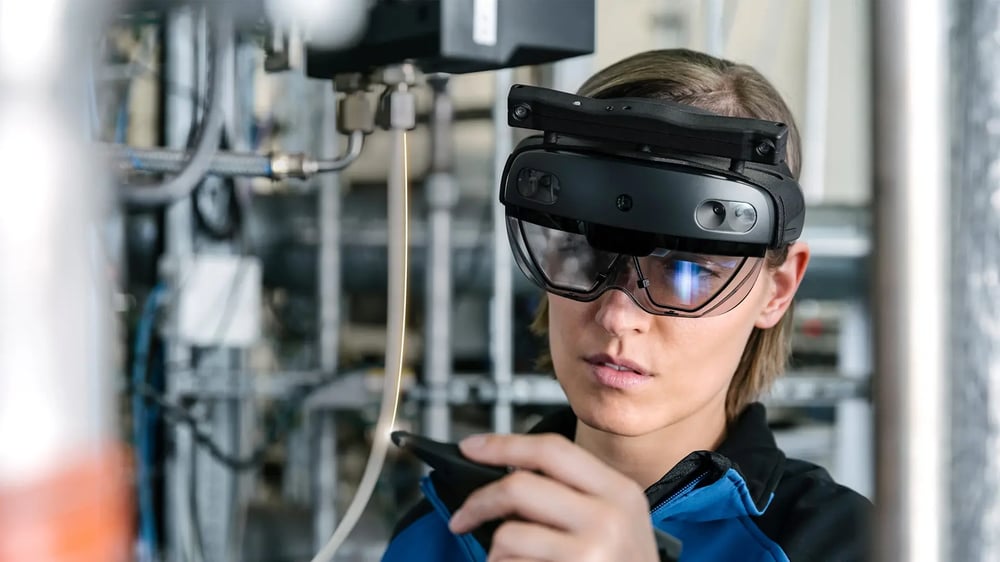
Engineer plans new pipes in an existing plant.
AR Workspace for Engineers
To be specific, BASF engineers use Hololight Space for the planning and expansion of intermediate product plants. Using AR glasses, the software offers experts a tool for visualizing, manipulating and collaboratively processing CAD data — for example from PLM systems — as holograms in a real environment.
With the help of Hololight Space, engineers can retrieve planned pipelines and assemblies directly to their intended destination. Using the digital twin, it is thus possible to quickly determine whether planning and reality are compatible or whether changes are still required in the project. "What-if" test scenarios also give engineers a better understanding of their planned factory layout. And even during the engineering phase, on-site monitoring helps to detect and eliminate deviations early on before they lead to subsequent problems.
"It's not as if you are placed in a virtual environment — I can see quite normally, like looking through sunglasses. It's just that the parts I want to see, which I have transferred to the AR glasses, are visible at the same time," describes Felix Volkmann, Asset Manager at BASF.
The same approach extends directly into maintenance and support: step-by-step instructions and digital information can be made available to technicians at the exact location in the plant where they are needed, accessed via AR headsets on-site.
Collaboration Made Easy
Factory planning has always been a discipline characterized by diverse influences from different departments. The interests of mechanical and plant engineering meet the interests of civil engineering and architecture. The Augmented Reality Engineering Space provides a collaborative environment to bring together different stakeholders. The software suite enables a very uncomplicated, fast and above all smooth experience of complex 3D models in a collaborative space. This means that all stakeholders can come together for a virtual engineering meeting regardless of location and work together on the CAD object. All the information noted in the working session or adjustments made to the digital 3D model can then be seamlessly integrated into the automation systems of subsequent workflows. This ensures cooperation across departments, divisions and plants.
A review in the form of an augmented reality meeting also has the additional advantage that inconsistent details, easily overlooked design errors or even necessary modifications to the model can be quickly identified or implemented by the specialist departments. Companies save their resources and make the planning process more efficient. It is also conceivable that factory planners and customers could jointly sketch, discuss and further develop designs or ideas in augmented reality. The customer can decide whether the production environment meets his requirements and the experts can plan and develop in a more targeted manner.
Get More from CAD
Basically, the AR working environment serves as a planning and collaboration platform. At BASF, for example, the 3D viewer Hololight Space makes planning more efficient and reduces construction errors. The visualization, manipulation and exchange of information are made easy by the intuitive handling. The appropriate augmented reality software is therefore not only a tool that generates advantages at the corporate level, but also supports engineers in their practical planning work by providing better, extended handling of CAD data.
And especially in times of social distancing, it is also an absolute advantage to rely on a collaboration tool that enables employees to continue working on important programs and projects. Without risk and even across large geographical distances. These advantages will not lose their effect even after the current virus crisis has been overcome. What acutely helps to further digitalize planning can in the long term create the basis for more efficient collaboration and optimize the entire engineering workflow.