6 min read

AR Headsets in 2026: Building an XR Strategy for a Fast-Moving Market

AR Headsets in 2026: Building an XR Strategy for a Fast-Moving Market
9:43

At a glance

The enterprise AR and VR device market is busy: significant new hardware is arriving in 2026, including PICO's Project Swan and Snap's next-generation Spectacles, and like the latter, the broader market is moving toward lighter, more wearable form factors.

But lighter hardware creates a performance problem: compact devices cannot handle enterprise-grade XR workloads on their own. XR streaming solves this by moving rendering off the device entirely. It also solves a broader strategic problem: the market changes fast, vendors shift roadmaps on their own schedule, and any XR strategy built around a single device carries risk. XR streaming decouples applications from devices, so whatever hardware comes next, organizations are already ready for it.


2026 is shaping up to be a significant year for enterprise XR hardware. The device landscape that organizations must now navigate spans a wider range of form factors, operating systems, and use cases than the category has ever offered: high-fidelity passthrough headsets capable of photorealistic mixed reality, dedicated optical AR devices built for the factory floor, and an emerging tier of lightweight AR glasses that points toward something closer to how people have always imagined AR would eventually look and feel.

For enterprise buyers, the breadth is both an opportunity and a complication. More choice means better fit for specific use cases. It also means greater exposure to the risk that comes with any fast-moving hardware market: the device or platform an organization builds around today may look very different — or be gone entirely — within a few years. The question is not just which device to choose, but how to build an XR strategy that remains coherent as the hardware keeps changing.

This article maps where the market stands, what is arriving, and why the infrastructure layer beneath the devices has become as consequential as the devices themselves.


Where the Enterprise XR Device Market Stands Today


The current generation of enterprise-ready XR hardware falls into three broad categories, each suited to different deployment contexts and use cases.

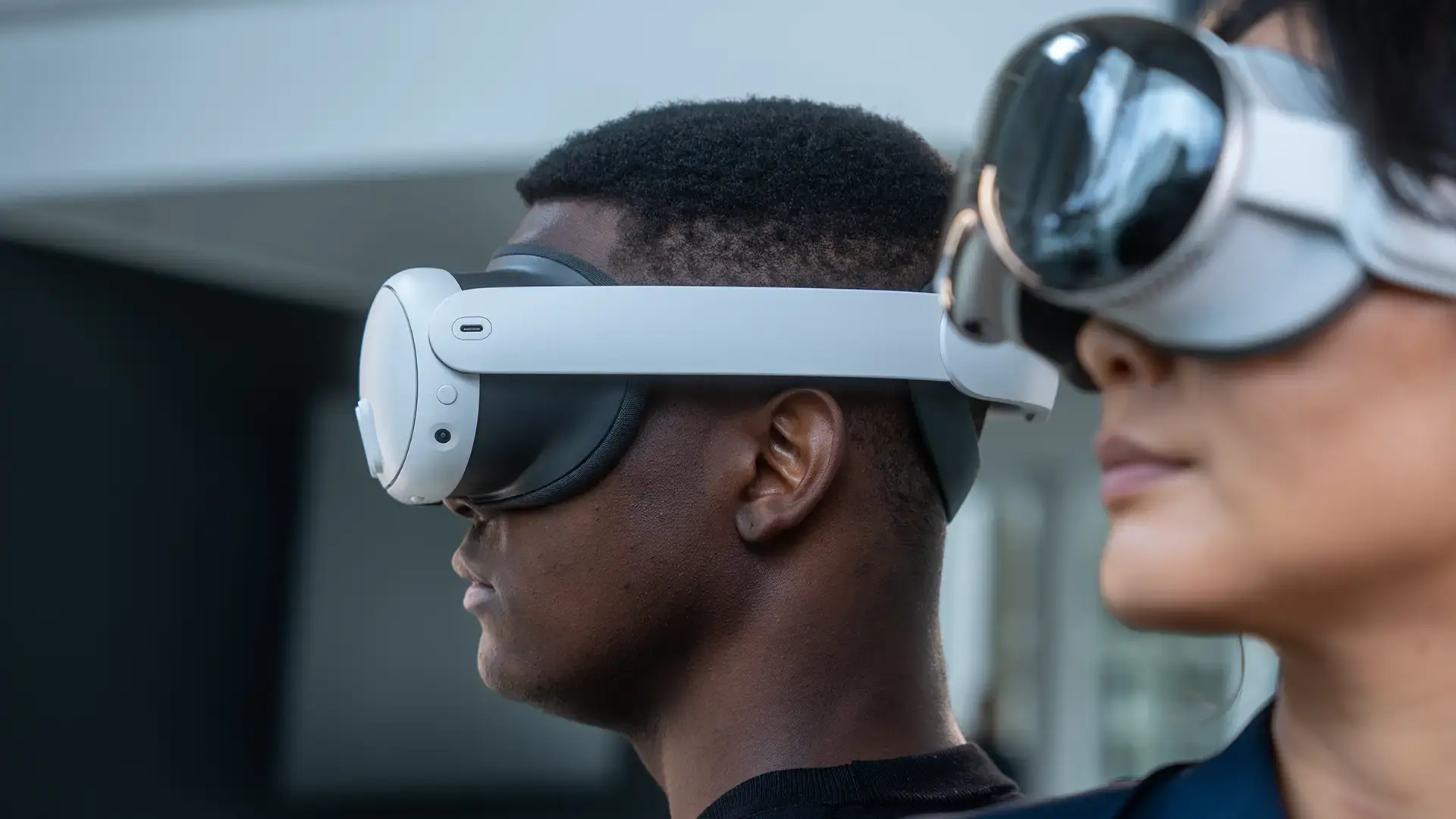
Passthrough mixed reality headsets are the most widely deployed category in enterprise today. Rather than using transparent lenses to overlay digital content on the real world, they use cameras to capture the environment and blend digital elements into the live video feed — a technical approach that delivers richer visual integration, more realistic lighting and occlusion, and greater flexibility between immersive and mixed-reality modes. The trade-off is a slight visual mediation of the real world, which matters for some industrial tasks and much less for others.

The Apple Vision Pro sits at the premium end of this category. Its launch in early 2024 set a new reference point for what display quality, hand tracking, and spatial computing could look like when treated as primary engineering requirements — not features added to a gaming platform. For organizations running design reviews, client-facing visualization, or high-stakes engineering collaboration, it has already established practical enterprise use. Hololight Stream supports the Apple Vision Pro, enabling streaming of industrial 3D content, including photorealistic ray-traced scenes, with all underlying data remaining within company infrastructure.

The Meta Quest 3 and PICO 4 Ultra Enterprise occupy the mid-range of this category, at price points that make fleet deployment realistic across teams and multiple locations. Both deliver high-quality mixed reality and strong standalone performance. The PICO 4 Ultra Enterprise is specifically designed with shared-device, multi-user enterprise environments in mind. Both are supported by Hololight Stream.

Dedicated optical AR headsets, where digital content is overlaid on the real world through transparent lenses, keeping the user's natural field of view unmediated, represent the category most directly associated with traditional enterprise AR use cases: assembly guidance, maintenance workflows, remote expert support, hands-free operation in industrial environments. With Microsoft having ended active HoloLens development, the most significant new entrant in this space is the HMS SiNGRAY G2.

Developed by Japanese technology company HMS, the SiNGRAY G2 is explicitly positioned to serve the industrial enterprise customers left without a clear hardware path by those departures. Its specification sheet reflects serious engineering intent for demanding field environments: dual 1920×1080 Micro-OLED displays at 90Hz, a Qualcomm QCS8550 chipset with an Intel Movidius Myriad X vision co-processor, IP65 ruggedization, and a hot-swappable 4,800mAh battery designed for continuous full-shift use. Developer kits became available in late 2025, with mass production planned for early 2026. Hololight has worked with HMS, and the device's OpenXR compatibility means Hololight Stream can deliver enterprise applications to it without requiring custom development per device — the same principle that governs Hololight's support across its entire device portfolio.

Lightweight AR glasses represent a distinct category, a clear signal of where the hardware is heading. Snap Spectacles are the most notable current example: a lightweight, wearable see-through AR device with a fundamentally different form factor from any headset currently deployed at enterprise scale. Hololight has partnered with Snap to bring XR pixel streaming to Spectacles, enabling high-fidelity interactive 3D applications on hardware that a user can simply wear, with full support for hand tracking, interaction, and audio streaming. Snap's next generation of Spectacles is planned for public launch in 2026.


What Is Arriving: The 2026 Hardware Pipeline


Two announcements from early 2026 are worth attention as indicators of market direction, both involving manufacturers Hololight already supports.

In March 2026, PICO unveiled Pico OS 6 and shared preliminary details about Project Swan, its next flagship headset planned for global launch in late 2026. What is publicly known positions Project Swan as a meaningful step forward in display quality and processing capability: micro-OLED panels targeting approximately 4,000 PPI and a center resolution of around 40 PPD — specifications that place it in direct comparison with the Apple Vision Pro — alongside a dual-chip architecture claiming more than double the CPU and GPU performance of the current XR2 Gen 2 chipset, and a custom vision processor targeting approximately 12 milliseconds of perception latency. The accompanying operating system, Pico OS 6, introduces a 360-degree multi-application workspace called PanoScreen. Notably, PICO has framed this explicitly as a move from gaming toward general-purpose spatial computing and workplace productivity — a positioning that signals where the company sees its enterprise opportunity. Project Swan supports OpenXR, WebXR, Unity, and Unreal, which from a development perspective means existing XR applications can target it without significant rework. Given Hololight's existing support for the PICO ecosystem, compatibility with Project Swan is a natural extension.

The broader pattern that Project Swan, alongside Snap's next-generation Spectacles, reflects is a market moving toward hardware that takes enterprise and professional productivity seriously as a primary use case rather than an afterthought to consumer positioning. The display quality benchmarks being targeted and the software platforms being built around them suggest that 2026 is a meaningful inflection point: the year the category starts making a credible case for XR as a daily productivity environment, not just a dedicated session tool.


The Hardware Constraint No Chip Generation Will Eliminate


Across all of these device categories, current and incoming, there is a structural constraint that the hardware roadmap alone cannot resolve. Delivering high-quality XR experiences requires significant computing resources: rendering complex 3D environments with realistic lighting and materials, processing spatial tracking data across multiple cameras, maintaining the frame rates that prevent discomfort. That compute requires power, generates heat, and adds weight and bulk to whatever device carries it. The more capable the standalone headset, the heavier and warmer it becomes, and the faster it drains its battery. The more compact and wearable the device, the less computing it can carry on board.

This is not a constraint that successive chip generations will eliminate. The physics are constant: more capable processing requires more energy, and more energy means more thermal load and battery weight. What each new chip generation does is shift the trade-off marginally — but the trade-off itself remains. A device optimized for wearability will always sacrifice some computing capacity compared to one optimized for raw performance. The gap between what lightweight hardware can render locally and what enterprise 3D workloads actually require has not closed, and will not close at the rate the application demands are growing.

The architectural response to this is to move the compute off the device entirely. If the headset's role is to receive a stream of rendered pixels, display them, and transmit sensor data back rather than to run the application local, then the device's own processing capability becomes largely irrelevant to the quality of the experience. The rendering happens on infrastructure the organization controls: a workstation, an on-premises server, or a cloud environment within the company's own tenant. Only the resulting images travel to the device over the network. The headset becomes a display and sensor terminal: lightweight, thermally efficient, and not a bottleneck.

This is the architecture that makes lightweight AR glasses viable for serious enterprise use today rather than remaining a future aspiration. It is also what allows current passthrough headsets to handle industrial-grade 3D content — large-format digital twins, high-polygon CAD assemblies, complex factory models — that would be well beyond their standalone rendering limits. And it is the reason that an organization running on streaming infrastructure is not meaningfully affected when a new, more capable headset enters the market: the infrastructure continues unchanged on the backend; the device on the user's face is simply an upgrade.


Device-Agnostic by Design: The Only Durable XR Strategy


The history of this market offers a consistent lesson. Organizations that built their XR workflows tightly around a single hardware platform have found, repeatedly, that the platform does not hold still. Microsoft for example completely ended active HoloLens development. Vendors that looked established have exited or repositioned. And the organizations most exposed in each case were those whose XR architecture was the least portable — where the application, the workflow, and the device were so tightly coupled that any change to the hardware required rebuilding from the application layer up.

The organizations that have navigated these transitions most smoothly share a common characteristic: their XR architecture was designed around an infrastructure layer independent of any specific device. Applications run on servers or workstations the organization controls. Sensitive data stays within the company's infrastructure perimeter. The headsets in use at any given moment are interchangeable surfaces — the same application streams to whatever device makes sense for the task, the team, or the budget, without modification.

Hololight Stream supports all major current enterprise XR headsets — including the Apple Vision Pro, Meta Quest 3, PICO 4 Ultra Enterprise, Snap Spectacles, HMS SiNGRAY G2, and HoloLens 2 in maintenance mode — and the platform is designed to extend to new devices as they arrive. When Project Swan launches, when the next generation of lightweight AR glasses reaches enterprise readiness, when whatever comes after enters the market, the applications and workflows running on Hololight Stream continue without modification. The device on the user's face changes. Everything else stays the same.

For organizations evaluating their XR strategy in 2026, that continuity is the most important specification on the list.


For a detailed look at how Hololight’s XR Streaming architecture works across all major devices:

More about Enterprise XR Streaming

AR Headsets in 2026: Building an XR Strategy for a Fast-Moving Market

AR Headsets in 2026: Building an XR Strategy for a Fast-Moving Market

At a glance The enterprise AR and VR device market is busy: significant new hardware is arriving in 2026, including PICO's Project Swan and Snap's...

See Updates
The Complete Beginner’s Guide to AR, VR, and XR in Industry

The Complete Beginner’s Guide to AR, VR, and XR in Industry

What XR Really Means XR (Extended Reality) is an umbrella term for Virtual Reality (VR), which creates a fully digital environment, Augmented...

See Updates
Why AR in product development is easier to adopt than you think

Why AR in product development is easier to adopt than you think

Augmented Reality is already delivering measurable results in product development: from faster design cycles to fewer errors and lower costs. But...

See Updates