
 Laura Haase
What's New in Hololight Stream 2026.1.0.0
 Phillipp Landgraf: Oct 8, 2026
Hololight Stream version 2026.1.0.0 is available. It is a broad release, with work going into stability, connection quality and the everyday...
XR (Extended Reality) is an umbrella term for Virtual Reality (VR), which creates a fully digital environment, Augmented Reality (AR), which adds digital elements to the real world, and Mixed Reality (MR), where users can interact with both physical and virtual objects at the same time. In industry, XR helps teams understand, review, and work with complex 3D information more naturally than on a 2D screen.
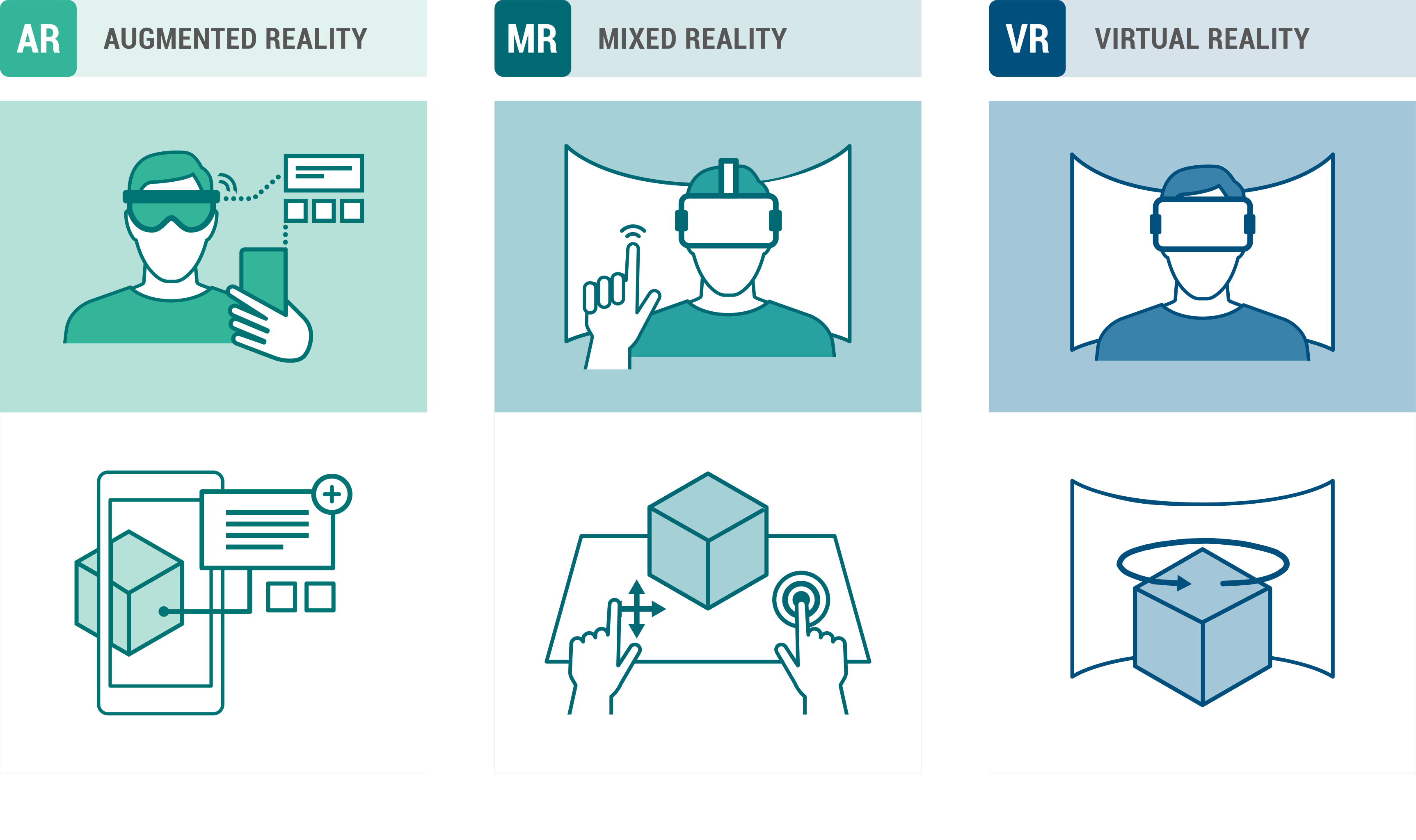
VR creates a completely digital environment and blocks out the real world.
It is used when full immersion is required, for example:
evaluating designs at full scale
testing spatial layouts
training scenarios that need controlled environments
multi-user engineering reviews
Devices: Pure VR headsets are getting increasingly rare, as many headsets go with a passthrough option today, but an example for a pure VR headset would be the Varjo VR-3.
AR adds digital elements to the real world: Digital objects or information can be overlaid onto the real environment. Users see their actual environment while digital elements appear in it, useful for:
assembly guidance
engineering and maintenance tasks
remote assistance
mixed physical–digital workflows where awareness of surroundings is essential
Devices: Snap Spectacles, HMS SiNGRAY G2, Microsoft HoloLens 2
Passthrough XR uses cameras on the headset to show the real environment and blend digital objects into the scene. Unlike optical AR, passthrough allows for more realistic lighting and occlusion, higher-fidelity digital visuals and seamless “AR-like” interaction even with opaque headsets.
It is used when teams need both immersion and awareness of physical space, such as:
detailed engineering reviews
spatial layout planning
collaborative design walkthroughs
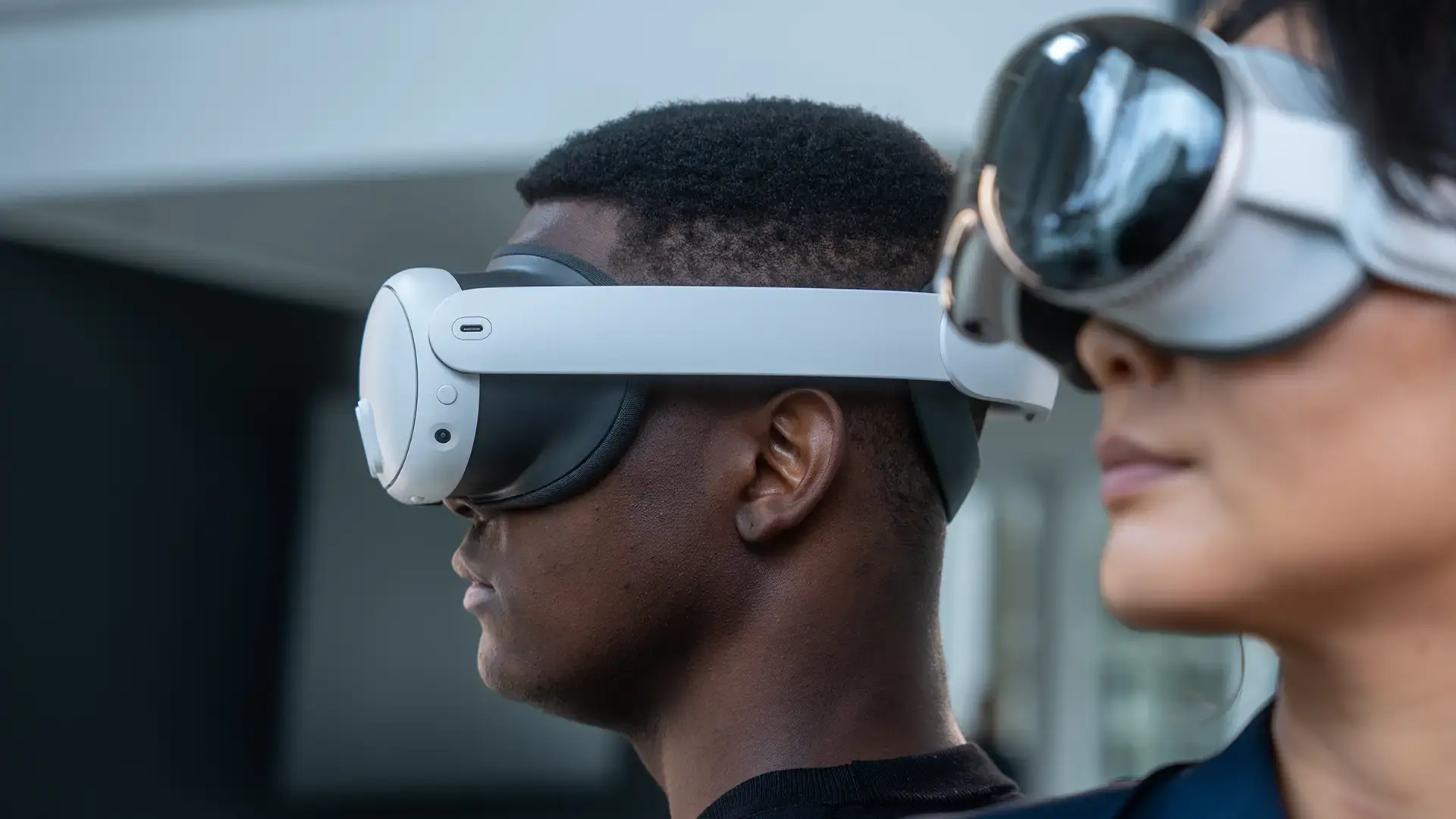
Devices: Apple Vision Pro, Meta Quest 3, PICO 4 Ultra Enterprise
For many companies, XR is becoming a natural extension of their existing CAD, visualization, and simulation tools. Organizations adopt XR because it helps teams:
While XR devices offer powerful features, they have limited processing power. This is where AR/VR Streaming, powered by Hololight Stream, comes in. By offloading rendering to external servers, XR Streaming allows businesses to use complex 3D applications without hardware constraints, making AR and VR more accessible and scalable.
Virtual Reality (VR) creates a fully digital environment that replaces your real surroundings. When you put on a VR headset, everything you see is computer-generated, allowing you to step inside a virtual space. This kind of full immersion is useful anytime teams need to focus entirely on a design, prototype, or scenario without distractions from the physical world.
VR uses special hardware and software to create a realistic digital experience. Here’s how it works:
Headset & Display – A VR headset covers your eyes and shows you a digital world in 3D.
Motion Tracking – Sensors track your head movements so the view changes as you look around.
Controllers – Some VR systems include controllers, which let you interact with the virtual environment, such as picking up objects or pressing buttons.
Sound & Haptics – Many VR systems include 3D audio and vibration feedback to make the experience even more immersive.
VR is widely used in engineering, manufacturing, and industrial training to understand complex 3D information more clearly, accelerate decision-making, and simulate processes before anything physical exists. Because VR replaces the real world entirely, it is ideal for situations where teams need full focus, controlled environments, or the ability to test ideas without physical risk or cost.
Examples include:
exploring full-scale factory layouts to identify spatial or workflow issues early
conducting immersive engineering reviews of digital prototypes before building anything
training technicians or operators on procedures without interrupting production
simulating hazardous or hard-to-access environments for safety training
While these use cases offer immense value, the massive 3D CAD datasets required for industrial-grade VR often exceed the processing power of standalone headsets. To visualize these complex models without compromising on detail or security, organizations are turning to high-performance VR streaming. This allows the heavy computing to happen on a powerful server, while the user experiences a seamless, high-fidelity virtual environment.
Instead of replacing your surroundings like VR does, augmented reality (AR) enhances what you see with 3D models, instructions, or data that appear directly in your field of view. Because you remain aware of your physical environment, AR is especially useful in industrial settings where hands-on tasks, safety, and spatial context matter.
AR can be experienced through smartphones, tablets, or specialized AR headsets. In industry, dedicated AR glasses are typically preferred because they allow workers to remain hands-free while interacting with digital information.
AR works by using a camera, sensors, and software to detect the real world and place digital objects into it. Here’s how it happens:
Camera & Sensors – The device scans the surroundings to understand where to place digital objects.
Software Processing – The system processes the real-world image and adds digital elements on top.
Displaying AR – The digital content appears on your headset, making it look like it’s part of the real world.
AR is widely adopted across engineering and manufacturing because it brings digital information directly into real work environments. Companies use AR to guide workers through complex tasks, evaluate 3D models in the correct spatial context, and support collaboration without needing physical prototypes.
Examples include:
step-by-step assembly or maintenance instructions directly in the user’s field of view
placing full-scale 3D models in real environments for engineering validation
remote expert support, where specialists can annotate the user’s view in real time
on-the-job training, where workers practice procedures in context before touching real equipment
inspecting virtual prototypes during automotive or aerospace reviews to reduce iteration time
To make AR more accessible and comfortable for extended use, there is a strong move toward sleeker, lightweight hardware. However, a smaller physical footprint typically means less room for onboard processing power and battery life. This creates a performance gap that XR streaming effectively bridges. By offloading the heavy computing to a local server or the cloud, even the most compact AR glasses can display complex, high-fidelity digital content without the heat or weight of a traditional high-power processor.
Passthrough XR uses cameras on the headset to capture the real world and display it on the device’s internal screens, blending digital objects into the live video feed. The experience feels similar to AR, but with richer visuals, better lighting, and more realistic integration of digital and physical elements. Because the device can shift between mixed reality and full VR, passthrough XR is highly flexible for industrial use cases.
Devices such as the Apple Vision Pro, Meta Quest and PICO headsets rely on passthrough technology to offer high-quality mixed reality experiences.
Passthrough XR combines camera data, spatial tracking, and real-time rendering to create a merged digital–physical experience:
Cameras: Capture the real environment and stream it into the headset in real time.
Depth & Tracking Sensors: Map the space so virtual objects can be placed accurately.
Rendering Pipeline: Digital content is composited into the camera feed with correct lighting, depth, and occlusion.
Display: The user sees a seamless mix of the real world and virtual elements on high-resolution screens.
Passthrough XR is increasingly adopted in engineering and manufacturing because it offers the visual quality of VR with the contextual awareness of AR. Teams can place virtual prototypes into real environments, switch into full immersion when needed, or walk through design changes collaboratively.
Examples include:
evaluating 3D models with realistic lighting and materials
placing virtual equipment in real factory spaces to verify fit and accessibility
conducting collaborative design and layout reviews with multiple participants
presenting engineering concepts to stakeholders using high-fidelity mixed reality
testing ergonomic setups and workstations before physical build-out
To achieve this level of realism, Passthrough XR must process high-resolution video alongside complex 3D data. By using XR streaming, the intensive rendering happens on a secure central server rather than the headset. This allows devices like the Apple Vision Pro to display massive datasets with full visual fidelity, while ensuring that sensitive source data never leaves the protected corporate infrastructure.
AR and VR headsets will continue to evolve quickly, offering better visuals, smarter sensors, and lighter form factors, but their onboard computing power will always be limited. Industrial 3D data is simply too large and too complex to run on standalone devices. This is why AR and VR streaming will define the future of enterprise XR: rendering happens on a workstation or server, the original data stays securely inside the company's infrastructure, and any headset can access high-quality 3D content without extensive data preparation or conversion.
Hololight’s XR streaming technology and XR streaming platform make AR and VR flexible and future-proof. As new devices enter the market, from optical AR glasses to high-fidelity passthrough headsets, companies can adopt them without changing their workflows or reworking their 3D data. Hololight ensures performance, security, and scalability stay consistent, so organizations can focus on using XR where it delivers real value: faster decisions, fewer physical prototypes, and clearer collaboration across engineering and manufacturing.
If you work in manufacturing, engineering, or product development, the next step is understanding how XR applies specifically to your workflows: from design review and prototype reduction to quality assurance and team alignment across locations.
Adopting AR doesn't require a complete overhaul of your existing tools or processes. Our actionable guide breaks down how industrial teams identify their first high-ROI use case, choose the right device, and scale from a single workflow to broader deployment, with real examples from Hololight customers:
 Phillipp Landgraf: Oct 8, 2026
Hololight Stream version 2026.1.0.0 is available. It is a broad release, with work going into stability, connection quality and the everyday...
 Phillipp Landgraf: Oct 1, 2026
Remote rendering and pixel streaming are both used to describe enterprise XR streaming infrastructure, including by vendors and in technical...
 Sandro Sailer: Sep 24, 2026
For most enterprise teams, XR device management means one thing: a way to control their headsets. Mobile device management (MDM) tools like ArborXR,...