6 min read

XR Market Size & Growth: The Enterprise Inflection Point | Hololight

XR Market Size & Growth: The Enterprise Inflection Point | Hololight
10:31

The global XR market has cleared the point at which its scale needs to be argued. Grand View Research valued the XR market size at $142.39 billion in 2023 and projects it will reach $1.069 trillion by 2030, a 32.9% compound annual growth rate.1 The momentum behind that trajectory is now visible in device data: IDC reports XR device shipments grew 44.4% year over year in 2025, with display-less smart glasses shipments surging 167% in the first quarter of 2026 alone.2, 3

At this scale and pace, the question worth asking shifts. It is no longer whether XR is a serious enterprise category, but where XR market growth is concentrating, what it demands of the organizations inside it, and what separates programs that scale from those that stall before they get there.

This article covers:

  • ■  The top-line XR market size benchmarks, including enterprise spending and adoption
  • ■  How XR market growth is distributed across the enterprise verticals driving it
  • ■  Why accelerating hardware proliferation is an infrastructure problem, not just a procurement one
  • ■  What the deployment architecture behind scalable enterprise XR actually requires

XR Market Size at a Glance

The table below consolidates the top-line market and adoption figures that define where global XR investment stands today.

XR Market Size and Growth: Key Benchmarks

Category Metric Figure Source
Global Market Value (2023) Total market size $142.39B Grand View Research1
Projected Market Value (2030) Market forecast $1.069T Grand View Research1
Market CAGR (2024-2030) Growth rate 32.9% Grand View Research1
Enterprise AR/VR Spending (2025 est.) Annual enterprise spend $7.2B IDC4
Fortune 500 XR Adoption Share with XR in production or pilots 75%+ Treeview5
Enterprise Share of VR Revenue (2030) Projected enterprise share 60%+ Treeview5

Three findings from this data shape the context for the sections that follow.

First, a 32.9% CAGR built on a $142.39 billion 2023 base1 is not early-adopter momentum. It reflects the conversion of pilot allocations into recurring infrastructure spend across an already substantial market. Organizations are building on XR, not evaluating it.

Second, enterprise AR/VR spending reached an estimated $7.2 billion in 2025.4 That figure places XR in the same tier as standard enterprise technology investment, which means XR budgets are increasingly drawn from IT and operations rather than innovation or R&D funds. That shift changes the internal conversations organizations have about deployment requirements, accountability, and scale.

Third, the combination of 75%+ Fortune 500 adoption today5 and a projected 60%+ enterprise share of VR revenue by 20305 describes a compressed timeline. Most large organizations have already adopted XR in some form, and enterprise is on track to become the primary source of VR revenue within a few years. That leaves organizations still operating at pilot scale a narrow window to make the infrastructure decision before the pace of the market forces it.

XR Market Growth by Enterprise Vertical

Aggregate XR market growth figures include consumer, gaming, and entertainment revenue that follows a different adoption logic than industrial enterprise. The table below isolates the sectors driving strategic investment and maps their current adoption stage, primary use cases, and near-term outlook.

Enterprise XR Adoption by Vertical (2026)

Industry Adoption Stage Primary XR Use Case Growth Outlook
Defense and Aerospace Expanding rapidly Sustainment training, mission rehearsal, maintenance Very strong; data security requirements drive demand
Automotive and Manufacturing Active deployment Design review, digital twin integration, quality inspection Strong; linked to broader digital twin investment cycles
Healthcare Established Surgical simulation, clinical training, patient rehabilitation Strong; safety ROI is well-documented
Energy and Utilities Early-to-mid stage Safety protocols, field technician training Growing; regulatory training pressure
Education (Higher Ed) Early stage STEM simulation, vocational training Moderate; budget constraints limit pace

Market sizing figures: Grand View Research, IDC, Treeview Studio.1, 2, 5 Adoption stage and outlook reflect Hololight's assessment of enterprise deployment patterns.

The three verticals with the strongest near-term trajectory (defense, automotive, and manufacturing) share a structural profile that explains both why adoption is accelerating and why deployment is demanding. These organizations work with complex 3D data, distributed workforces across multiple facilities, and data governance requirements that most standard XR tools were not designed to meet.

In defense, classified training content cannot reside on shared devices. In automotive, full-fidelity CAD assemblies at production scale exceed the rendering capacity of standalone headsets. In manufacturing, a mixed device fleet across multiple sites requires centralized update and access management that per-device setup cannot deliver.

Growth in these verticals follows the resolution of structural deployment problems. The programs that scale tend to be the ones that solved data governance, mixed-fleet management, and multi-site delivery before expanding.

The Hardware Proliferation Problem

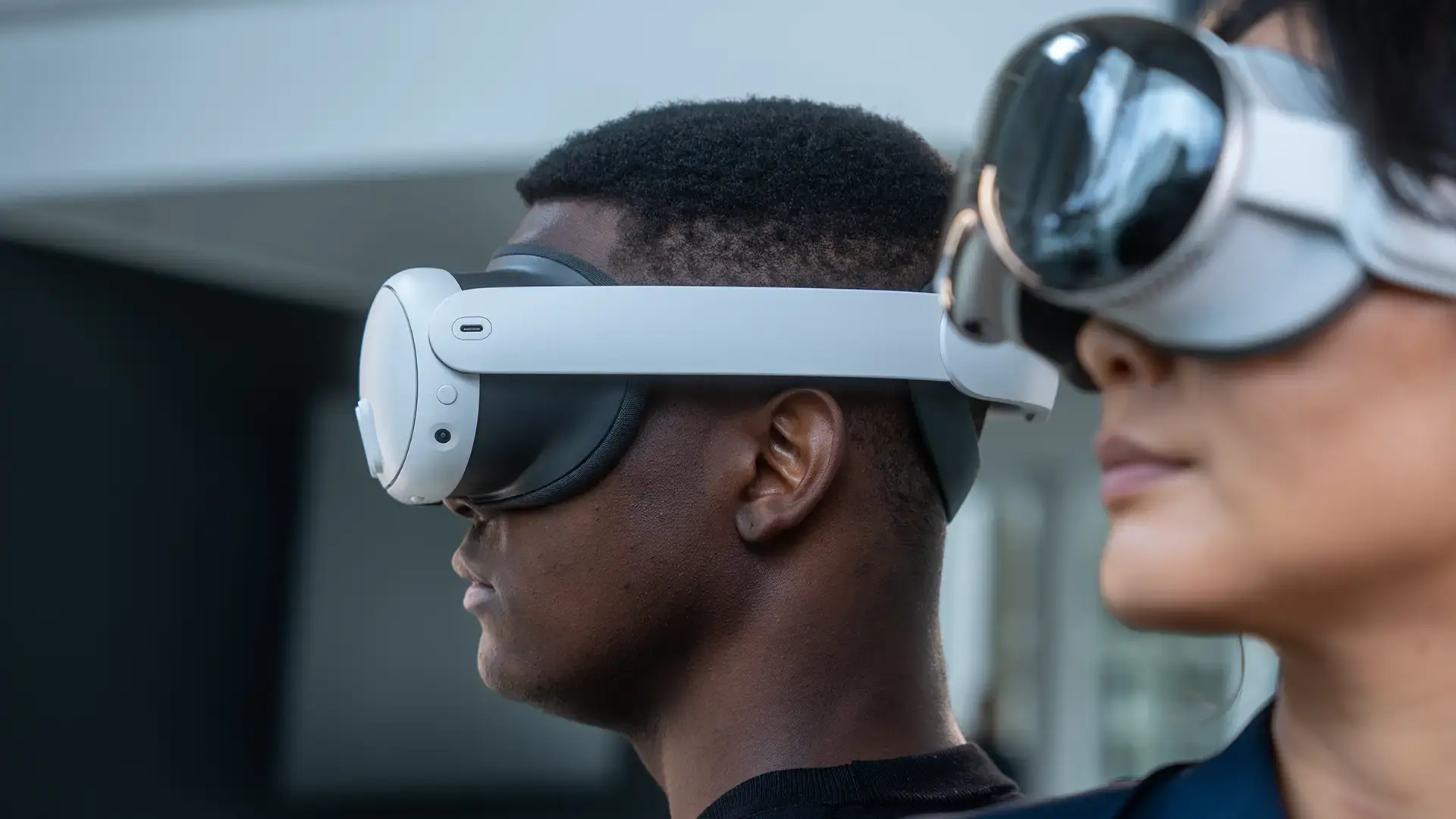
XR device shipments grew 44.4% in 2025, and IDC projects another 33.5% growth in 2026.2, 3 Smart glasses, mixed reality headsets, and optical AR displays are each expanding on their own curve, so the category is diversifying at an accelerating rate rather than consolidating around a single device type.

For enterprise IT teams, that diversification carries a specific implication. Each new form factor arrives with its own runtime, its own rendering requirements, and its own hardware constraints. The Apple Vision Pro, Meta Quest, PICO 4 Ultra Enterprise, HTC Vive, and Snap Spectacles are all viable enterprise devices, but no single native runtime spans all of them, and no one application build runs natively across the full set.

An organization that builds its XR workflow around a specific device generation today is making an architectural decision it will likely have to revisit within 18 to 24 months as the market shifts. The durable question is not which headset is best now but whether the layer beneath the headset holds steady as the hardware underneath it turns over.

A proliferating device landscape creates four recurring problems:

  • ■  Applications built for one headset require separate builds for each additional device type without a common runtime
  • ■  Centralized update management, access control, and session monitoring are not deliverable through per-device tools
  • ■  Sensitive industrial and defense data cannot reside on shared or mobile endpoints, regardless of which headset is used
  • ■  Multi-site deployments without centralized management scale the administrative burden at the same rate as the device fleet

Hardware volume is the visible part of the XR market size story. The infrastructure layer that this investment depends on, and that most device-level tooling has not kept pace with, is the part that determines whether any of it scales.

What Enterprise XR Market Growth Actually Requires

The market data reflects a category that has cleared the proof-of-concept phase. Effectiveness benchmarks for enterprise XR are established and the ROI case holds at scale. What aggregate forecasts do not account for is the deployment layer, and that is where most enterprise programs meet their actual ceiling.

The pattern is consistent across verticals. A pilot works. The use case is validated. The organization tries to expand to more users, locations, and device types, and structural limits appear. They are not hardware limits but infrastructure limits: data that cannot safely reside on devices, applications that do not transfer across headset models without rebuilding, update and access management that does not scale with the fleet.

The architectural answer to each of those failure points is the same: move rendering and data off the device. In a pixel streaming architecture, the application executes on a server and only the rendered pixels are transmitted to the headset, which functions as a display and input terminal. The application runs remotely, and the device never receives the underlying data. That distinction matters in three specific ways:

  • ■  Security by default. Sensitive data stays inside the customer's own infrastructure. There is no polygon reduction, no data preparation, and no exposure on shared endpoints. The security posture an organization has already built is preserved rather than worked around.
  • ■  Device agnosticism. Any OpenXR-compatible application streams to all supported headsets without modification. A single application reaches Meta Quest, Apple Vision Pro, PICO 4 Ultra Enterprise, HTC Vive, and Snap Spectacles from the same server. (For why the choice of runtime standard is an infrastructure decision rather than a developer preference, see the OpenXR vs. OpenVR guide for enterprise developers.)
  • ■  Centralized management at scale. Updates deploy from a single point and access is controlled through a single platform. Fleet management becomes a network and infrastructure function rather than a per-device process.

This is the architecture behind Hololight Stream, built on a proprietary technology stack that is optimized for NVIDIA RTX GPUs and developed independently of NVIDIA CloudXR or any third-party engine. Because the rendering happens on the server, device-agnostic delivery does not come at the cost of visual fidelity or performance. It makes Hololight the only complete, proprietary enterprise XR streaming infrastructure stack on the market. Hololight's XR pixel streaming technology is part of Lockheed Martin Skunk Works' 5G Pixel Streaming Kit for defense sustainment work, through an ongoing collaboration. BMW, ENGIE Refrigeration, Felder Group, and Genesis Design Studios have integrated Hololight into standard workflows across mixed-device environments where device-agnostic deployment and on-premise data control are operational requirements rather than preferences.

The organizations aligned with the growth projections in this report are, in most cases, the ones that resolved the infrastructure question before scaling their device fleets. The XR market size numbers describe the opportunity. The infrastructure decision determines whether a given organization reaches it.

See the Infrastructure Layer in Action

The data above reflects an XR market that has moved past the adoption question and into the infrastructure question. XR market growth rates are well-supported across major research sources, enterprise spending is no longer a research allocation, and Fortune 500 adoption is a baseline rather than a leading indicator. What determines whether an individual organization captures the operational value behind those figures is whether the deployment architecture beneath its XR program can support the scale at which the advantages become real.

To see how Hololight's XR pixel streaming technology and central orchestration platform, Hololight Hub, handle enterprise XR deployment across device types, sites, and security requirements, schedule a demo with our team.

Last updated: August 7, 2026.

Sources

  1. 1.  Grand View Research. Extended Reality (XR) Market Size and Share Report, 2024–2030. grandviewresearch.com/industry-analysis/extended-reality-xr-market-report
  2. 2.  IDC. Augmented and Virtual Reality Headsets Market Insights, July 2026. idc.com/promo/arvr/
  3. 3.  SQ Magazine / IDC. Augmented Reality Statistics 2026: Market Size and Vendors. sqmagazine.co.uk/augmented-reality-statistics/
  4. 4.  IDC. Worldwide Augmented and Virtual Reality Spending Guide, 2025. my.idc.com/getdoc.jsp?containerId=IDC_P34919
  5. 5.  Treeview Studio. AR/VR/MR/XR Spatial Computing Industry Statistics Report, 2026. treeview.studio/blog/ar-vr-mr-xr-metaverse-spatial-computing-industry-stats
XR Market Size & Growth: The Enterprise Inflection Point | Hololight

XR Market Size & Growth: The Enterprise Inflection Point | Hololight

The global XR market has cleared the point at which its scale needs to be argued. Grand View Research valued the XR market size at $142.39 billion...

See Updates
From CAD to VR: Reviewing 3D Models at Full Fidelity

From CAD to VR: Reviewing 3D Models at Full Fidelity

Your CAD model holds every detail of the design. Getting that model into a VR headset usually means giving some of that detail up. Teams simplify...

See Updates
Spatial Computing Companies Shaping Enterprise XR

Spatial Computing Companies Shaping Enterprise XR

If you searched for spatial computing companies, you probably want to know who the players are and how to tell them apart. The label is slippery,...

See Updates