
Learning in New Dimensions Through Augmented Reality Training
With XR software from Hololight and an AR headset, the Care Chemical Academy of the chemical company BASF simplifies and improves training in production.
BASF: AR-Guided Safety Training for Chemical Production
Every BASF production employee must complete mandatory annual safety exercises under the German Water Resources Act. Conventional training on physical exercise models was complex to organize and limited hands-on participation. BASF's Care Chemicals Academy replaced this with an AR-guided training scenario, delivered via Hololight Space — now the official training standard at the Ludwigshafen site.
- Organization: BASF Care Chemicals Academy
- Challenge: Delivering mandatory compliance training to 30–40 participants per session on complex procedures — with limited hands-on access to physical equipment.
- Solution: Hololight Space, used to deliver step-by-step AR-guided training scenarios on a partial physical model extended by virtual elements.
- Result: Every participant completes the full procedure hands-on; the format is now the official training standard at Ludwigshafen, with rollout underway across additional sites.
When do people learn best? When they enjoy it — and every participant can work through a hands-on process themselves.
To protect the environment, every BASF employee in production must complete compulsory annual exercises in accordance with the German Water Resources Act. "We want to get employees excited about new technologies and communicate safety-related aspects in an innovative way," says Renate Esswein, head of BASF's Care Chemicals Academy. Conventional training on the 360 kilogram exercise model was complex to organize. And only a few of the 30 to 40 participants in each training course even had the opportunity to change the gasket on the flange themselves.
Practical Exercises in Augmented Reality
According to Esswein, "those who are told or shown something often believe that they have already mastered it. In practice, however, the process is usually more complicated." In contrast, the transfer of learning is much greater when doing it on your own, and what you have learned is memorized better. In the new augmented reality learning scenario, training content and the joy of learning can now be combined in a playful way — with a decisive advantage: everyone has to try out the virtual pipeline model for themselves and lend a hand in practice. Each participant can complete the new training step by step.
The practical exercises are carried out on a real partial model, which is turned into a complete pipeline system by Hololight Space on the AR headset. The perception is thus extended by virtual elements. Gesture-based input and three simple voice commands control the program: "Start", "Yes" and "Next". The AR software guides participants through the training with 3D animations and speaker audio, so that each participant can complete the training at their own pace.
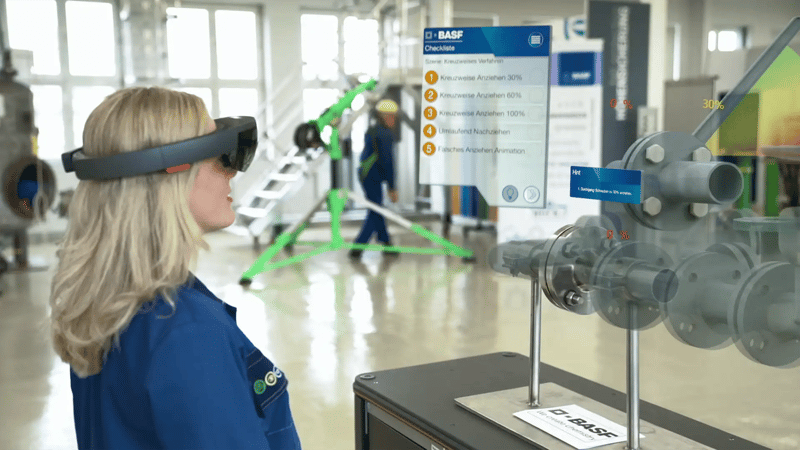
In BASFs AR Training, machine parts and instructions are overlaid onto a real world component.
AR Training Prevents Errors
"The technical content, the didactic structure and the design of the training course are provided by us, while we obtain the technical implementation from external sources," explains Mai Linh Ong, Specialist Care Chemicals Academy, who developed the storyboard for the training course. Together with the specialist colleagues from the Service Center Suppression and many consultations with the software developers of Hololight as well as end-users, it was determined step by step what the user can see through glasses and hear through the integrated loudspeakers. In the process, additions or specifications were made again and again. "This is a repetitive, iterative process in order to develop the training further in an agile way," emphasizes Ong.
The Augmented Reality training now also shows the consequences of incorrect actions: for example, what happens if, despite mandatory testing, there is still a residual product in the pipe system and the screw on the side away from the body is not opened first. Or what happens if the product runs out if the drip tray is not positioned correctly. "These things can be presented virtually without putting the participants in real danger," says Esswein, emphasizing the advantage. In the virtual scenario, the participant simply tries again until the process is complete. Gamification elements make it possible to convey the training content in a playful manner. Although the training should not be confused with a game, it is also fun, says Ong.
A New Training Standard at BASF
"The new training is very well received," says Renate Esswein. After a short period of getting used to the system, everyone is getting on well. Many are also amazed at how advanced the technology already is. And even experienced employees often experience an "aha" effect: "Hey, I didn't know that yet!" Since not all companies practice seal changes, but rather carry out other exercises on the Water Resources Act, the Augmented Reality program has been expanded to include additional topics: there are now training modules for the safe opening and closing of a screen basket filter, the installation and removal of blanking plates, as well as the installation and removal of pipe fittings.
Esswein and Ong confirm that Augmented Reality scenarios play an increasingly important role in the corporate environment. "It was a great advantage to test the new technology early on. It gives us the time to deal with the new possibilities without pressure," says Ong. The various training courses on the Water Resources Act in the new AR format are now officially recognized as the new training standard at BASF's Ludwigshafen site. What started as a pilot in the Care Chemicals division is currently being rolled out across the site, with extension to international locations under consideration. "This way we can ensure the quality of training and introduce global standards," Mai Linh Ong concludes.