
 Manuel Vogel
What's New in Hololight Stream 2026.1.0.0
 Phillipp Landgraf: Oct 8, 2026
Hololight Stream version 2026.1.0.0 is available. It is a broad release, with work going into stability, connection quality and the everyday...
From smart homes to self-driving cars, the Internet of Things (IoT) has enabled us to do things that were unthinkable just a few years ago. Now, thanks to the EU-funded IntellIoT project, it set out to take our interactions with IoT devices and systems to a new level. The project aimed to create intelligent environments that make use of semi-autonomous applications in areas such as agriculture and manufacturing – all while allowing human experts to maintain an essential role in controlling and teaching these AI-enabled systems.
In this article, we’ll take a look at how IntellIoT works and what it means for our future interactions with technology.
The concept of human-centered technology is at the heart of the IntellIoT project, and Hololight was one of over a dozen partners working together to create a framework that incorporates semi-autonomous applications in agriculture and manufacturing. In this model, humans retain oversight and control over AI agents and are responsible for any resulting outcomes.
Hololight contributed to the development of two use cases, including an augmented remote operation of an intelligent agricultural vehicle and a human-machine cooperation in shared manufacturing plants. Contributions included use case requirements, architectures, IoT/edge infrastructure management, as well as integration of Augmented Reality (AR) and Virtual Reality (VR) visualizations.
The agricultural industry is being plagued by serious and sometimes fatal accidents involving farming vehicles. To address this issue, the IntellIoT project developed an intelligent IoT environment which includes semi-autonomous agricultural vehicles. However, human intervention is still needed in uncertain situations such as when animals cross the vehicle path or when dust or other particles occur. Therefore, it is crucial that remote human operators refine the actions of the AI by taking remote control of the vehicle.
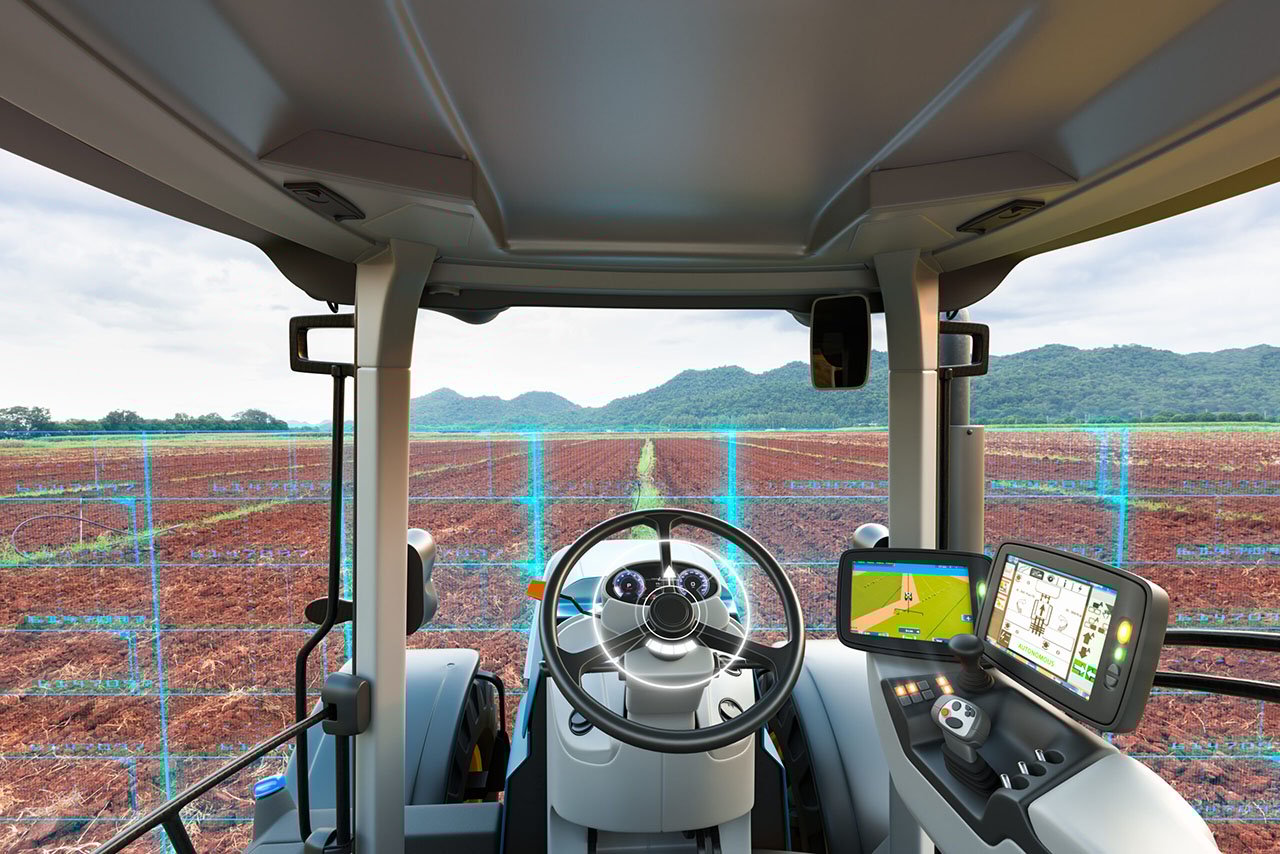
Using immersive technology, operators can view a 360° live stream from the vehicle, providing an up-close view of its surroundings. The implemented IoT/edge and networking infrastructure, combined with XR streaming technology provided by Hololight, further enables secure and reliable operation. Additionally, augmented data accuracy is achieved when real-time feedback from the operator, who can take manual control if needed, is used to enhance data received from the autonomous vehicles. This combination of manual and automated systems not only optimizes safety but also increases efficiency within the agricultural industry by providing better insights into operations, improving decision-making capabilities, optimizing cost savings, and maintaining productivity levels for greater yields throughout the year.
The agricultural vehicle use case also informed later work on 5G-enabled XR streaming — specifically the integration of L4S into Hololight's XR streaming technology in collaboration with Deutsche Telekom, which enables reliable streaming of AR applications over cellular networks in field environments.
Read how Deutsche Telekom and Hololight enable XR streaming beyond Wi-Fi
IntellIoT’s approach enables advanced, flexible, and individualized production in the manufacturing industry of the future. It allows shared manufacturing plants to operate more efficiently, with multiple customers utilizing them as a service. This system uses intelligent IoT technology to derive a production plan from product data received from clients and selects the necessary machines for each step of the process. Additionally, optimized transport paths are planned through a combination of robots, autonomous guided vehicles, and AI.
Where AI may not be sufficiently confident about a production step or workpiece handling, “human-in-the-loop” control can be employed via remote access, leveraging AR technologies to provide expert guidance to the AI. This ensures accuracy, reliability, and safety throughout all aspects of the operation, with tactile feedback being present and networks being secure. With these augmented inputs, AI systems can be further trained to increase efficiency.
Learn more about how Hololight supports manufacturing teams withXR
The IntellIoT project represented a significant step in the development of intelligent IoT environments. Combining AI, IoT technology, AR and VR with human expertise will enable novel use cases across multiple industries. The emphasis on distributed human-defined autonomy provides us with greater control over semi-autonomous systems – allowing us to maintain supervision while still taking advantage of their capabilities.
The use cases developed within IntellIoT – from agricultural fleets to shared manufacturing plants – demonstrate how XR streaming technology can serve as the interface layer between human operators and AI-driven systems in environments where reliable, low-latency connectivity and data security are critical.
 Phillipp Landgraf: Oct 8, 2026
Hololight Stream version 2026.1.0.0 is available. It is a broad release, with work going into stability, connection quality and the everyday...
 Phillipp Landgraf: Oct 1, 2026
Remote rendering and pixel streaming are both used to describe enterprise XR streaming infrastructure, including by vendors and in technical...
 Sandro Sailer: Sep 24, 2026
For most enterprise teams, XR device management means one thing: a way to control their headsets. Mobile device management (MDM) tools like ArborXR,...