Smart Glasses for Business: From Consumer Launch to Factory Floor
Smart glasses are arriving quickly, and nearly all of them are built for consumers. They translate signs and menus, answer questions about what is...
7 min read
Harsh Manoj Shah
August 20, 2026
Smart glasses are arriving quickly, and nearly all of them are built for consumers. They translate signs and menus, answer questions about what is in front of you, and capture without a phone. Those features are useful, including at work.
Industrial work asks for something else as well. Can a pair of glasses this light show a machine at full scale, in position, accurately enough to make a decision on?
This article covers what the current generation does well and which industrial jobs suit it. It also covers what has to sit behind the glasses for the demanding work.
In this article:
Two products share the name, and they do not do the same job. A third gets grouped with them in conversation, and it belongs in its own class.
The two categories called smart glasses, and the one that is not
| Category | What the user sees | Typical industrial fit | Where the rendering happens |
|---|---|---|---|
| Display-less AI glasses | No visual overlay. Camera, speakers, and microphone only | Hands-free capture, voice notes, remote calls | On the device and in a connected AI service |
| Optical see-through AR glasses | Digital content on transparent lenses, anchored to the real world | Overlay on machines, guided tasks, shop floor use | On the device, or on separate hardware through streaming |
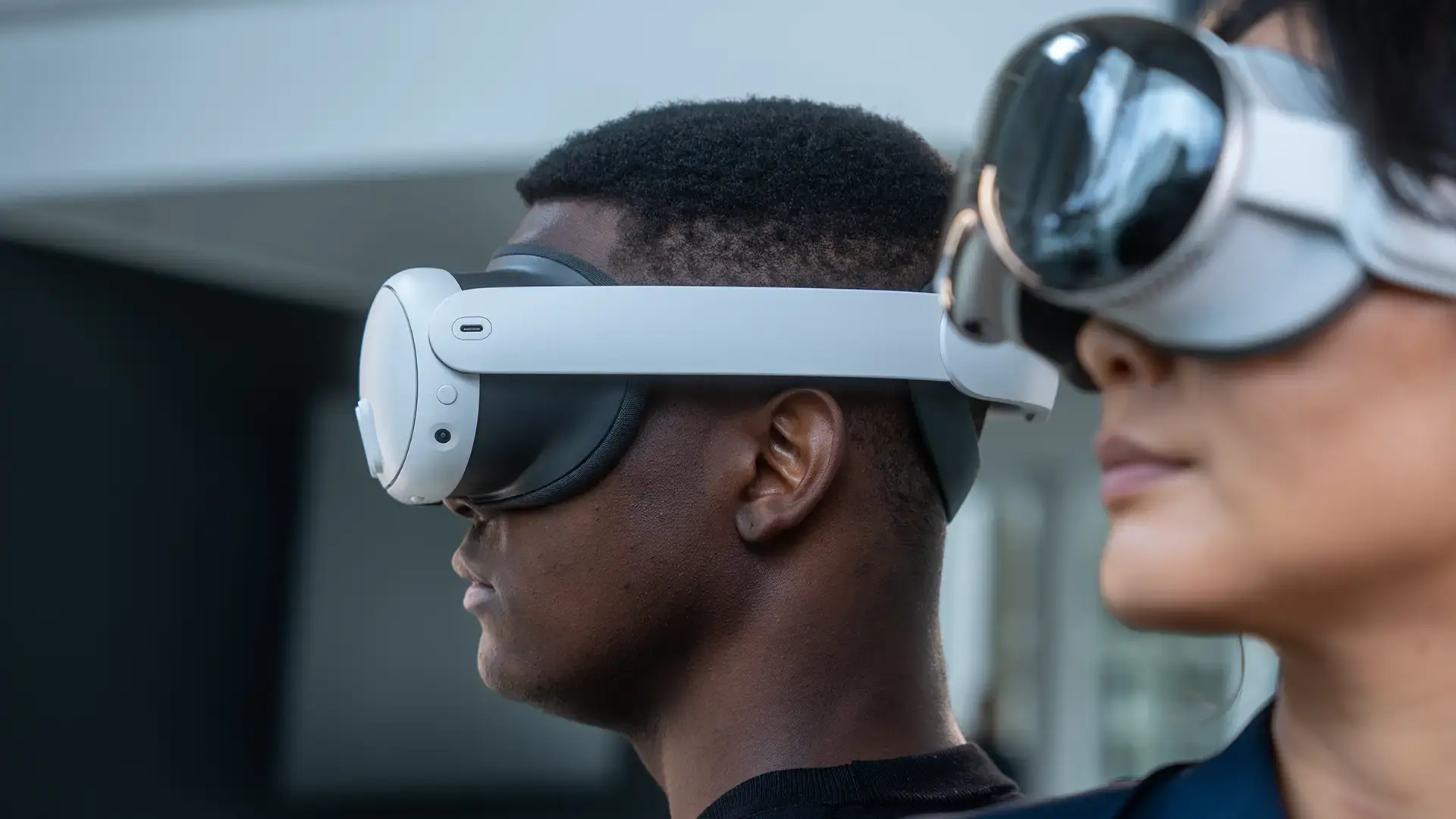
| Passthrough mixed reality headsets (a separate category) | The real world through cameras, with digital content blended in | Design review, detailed inspection, collaboration | On the device, or on separate hardware through streaming |
Display-less AI glasses are the volume story. IDC expects around 13.6 million units to ship in 2026, growing to 27.3 million by 2030.1
Optical see-through AR glasses make up a smaller segment that is growing faster. IDC puts it at roughly 3 million units in 2026 and 12.2 million by 2030.1
Passthrough mixed reality headsets are tracked separately again. They remain the most widely deployed category in enterprise today.
The distinction matters for anyone building a business case. A shipment figure quoted for one of these tells you nothing useful about the others.
An overlay is worth the hardware when the work happens in front of a physical object and both hands are busy. Five patterns come up repeatedly in industrial settings.
What these share is the real object in front of you and your hands staying on the work. That combination is what points to a see-through display worn on the face, rather than a screen or a tablet nearby.
Where the work happens decides which device fits. A design review runs for an hour, in a controlled room, and a passthrough headset suits that setting well.
A shift on the shop floor is a different setting. The user needs direct sight of moving machinery and peripheral awareness of the surroundings. Often that is under a helmet, for eight hours at a time. Lightweight see-through glasses are better suited for that, and they are a natural next step in those environments.
Work of this kind is already running on streamed content today, on see-through headsets like HoloLens 2, as in the Felder Group success story. Lightweight smart glasses are the next step in that same category. Broader guidance on picking a first workflow sits in our guide to AR in product development.
Checklist: signs your workflow suits smart glasses
See-through AR glasses have been available to businesses for years, mostly at enterprise prices and enterprise weights. What has been rare is a consumer product in that category. Snap's previous generation, Spectacles '24, was not sold outright. Access ran through a developer subscription at $99 a month on a twelve-month commitment.2
In June 2026 Snap unveiled Specs, its first consumer augmented reality glasses. Pre-orders opened in the United States, the United Kingdom, and France at $2,195, with shipping planned for fall.3
Snap Specs: published specification4
Three of those details matter more than the rest for industrial use. The weight sits in normal eyewear territory, which is what makes a full shift plausible rather than a demonstration. Adaptive tint handles the move between an indoor bay and an outdoor yard. Prescription support removes a real adoption blocker for a workforce that already wears glasses.
All of that describes display, sensing, and interaction. None of it describes rendering a machine. For the wider picture of how the device market is developing, see our overview of AR headsets in 2026.
The optics problem is largely solved. The compute problem is physics.
Rendering complex three-dimensional content takes processing power. Processing power draws energy, energy produces heat, and the components that supply and dissipate both add weight. All of it has to be carried on the wearer's head, all day.
Successive chip generations shift that trade-off. They do not remove it. The relationship between capability, power, and heat is physics, and it holds at any process node.
This is also why AI is what these glasses often lead with. This feature they ship with is real, but it is perception and language work. They recognize what is in view, understand a spoken request, and return an answer. Those are modest workloads that suit a compact device well.
Displaying a full engineering assembly is a different order of demand. An industrial model can run to millions of polygons, with accurate materials and lighting. It has to hold a stable frame rate while the user walks around it.
Two different kinds of workload
| Suits a lightweight frame | Exceeds a lightweight frame |
|---|---|
| Voice requests and spoken answers | Assemblies running to millions of polygons |
| Recognizing objects and text in view | Accurate materials, lighting, and reflections |
| Hand tracking and spatial anchoring | Stable frame rates across large scenes |
| Capture, playback, and simple overlays | Full-scale models with no simplification |
If the rendering does not have to happen on the glasses, the weight limit stops being a quality limit.
Hololight's XR pixel streaming technology runs the application on hardware the organization already operates. That means a workstation, an on-premises server, or its own cloud environment. Air-gapped deployment is available where a program calls for it.
The rendered images are encoded and sent to the glasses, which decode and display them. Only pixels travel.
Three things follow from that. Models stream at full complexity, with no polygon reduction and no file conversion. Teams work from the source data they already have.
Advanced lighting and ray-traced effects reach the device because the rendering makes full use of your NVIDIA RTX hardware. And the design data stays where it already lives, so the security policies already governing it keep applying, unchanged.
That last point tends to settle the question in aerospace, defense, and automotive programs. In those programs the model is the intellectual property. It stays inside the environment that already protects it.
The same logic reaches past 3D applications. Because the glasses only receive pixels, what runs on the server is an application question rather than a hardware question. A rendering application and an AI model can sit on the same server and reach the same pair of glasses. Pairing spatial guidance with AI context becomes a setup decision, not a device specification.
The practical effect is that the specification of the glasses stops determining what an engineer can look at. The frame handles display, sensing, and interaction, which is what it is built for. The demanding work happens on infrastructure built for that.
Checklist: what you need in place to stream to lightweight AR glasses
Yes. With the right streaming architecture you get the benefits of a light device without its compute limits. Smart glasses suit work that happens in front of a physical machine, part, or space. The user needs their real surroundings visible and both hands free. Assembly guidance, maintenance, remote expert support, and layout walkthroughs recur across manufacturing, aerospace, and energy.
AI glasses carry a camera, speakers, and a microphone but place nothing in your field of view. They answer questions, capture, and translate. AR glasses add a see-through display that anchors digital content to the real world. The two are not exclusive. When the work runs on a server and only pixels are streamed, AI context and spatial guidance can reach the same pair of glasses.
They can display them, though not render them locally at full complexity. With XR pixel streaming, the model is rendered on a workstation, server, or cloud environment the organization controls, making full use of your NVIDIA RTX hardware. Only the resulting images reach the glasses, so no polygon reduction or file conversion is needed.
Not for their built-in functions, which run on the device. For industrial 3D content, connecting them to rendering hardware is what lifts the quality ceiling. A frame light enough to wear all day cannot carry the processing that engineering models require.
Yes. Hololight works with CATIA files in enterprise review workflows, so design teams using Dassault Systemes tools can review those models in XR.
The consumer wave is producing the lightest wearable displays that have ever existed, and producing them at volume. That is good news for industry. The optics, the comfort, and the price all improve on a consumer development cycle rather than an enterprise one.
What the wave does not produce is the compute to render an engineering model. That capability does not fit in a frame anyone wants to wear all day. Streaming settles it by moving the work to hardware built for it. The glasses stay light, and what the engineer sees stays at full fidelity.
See how XR streaming works across AR and VR devices
Last Updated: August 20, 2026
Sources
Smart glasses are arriving quickly, and nearly all of them are built for consumers. They translate signs and menus, answer questions about what is...
Autodesk VRED is where automotive design gets validated. Designers, engineers, surface specialists, and perceived quality teams use it to build and...
Why Veteran Debt Assistance Provides 100% Free Financial Tools to Veterans and Why That Changes Everything The debt relief industry has a...