10 min read

Best Digital Twin Software for Industrial Visualization (2026)

Best Digital Twin Software for Industrial Visualization (2026)
10:31

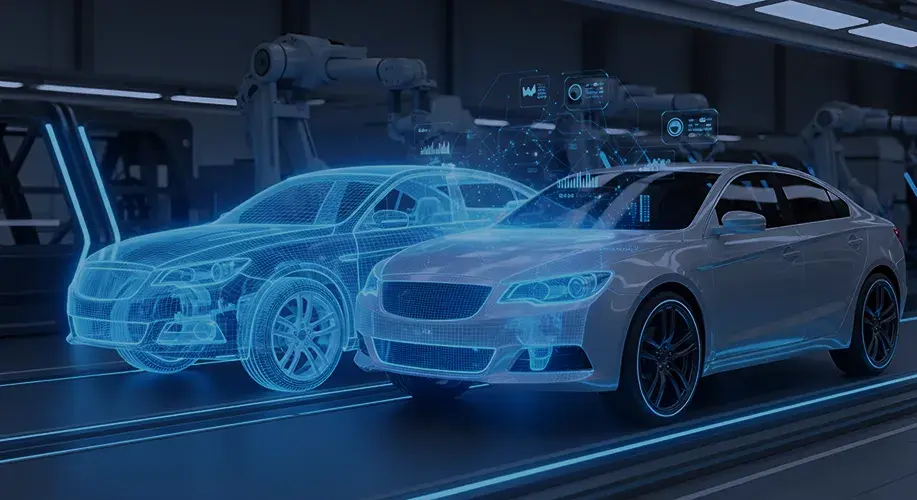
Enterprise digital twins are now production infrastructure in defense, automotive, and manufacturing. But a twin is only as valuable as the decisions it informs, and those happen on the floor and in the field. Which platform builds the twin and which layer delivers it to a headset are two different decisions.

Between February 2025 and July 2026, we scored five leading digital twin platforms on the criteria enterprise buyers weigh across defense, automotive, manufacturing, and infrastructure, using a weighted framework:

  • ■  Data Modeling Depth and Fidelity (25%): accuracy and completeness of the asset model
  • ■  Enterprise Scalability and Deployment (20%): distributed teams, central IT, multi-site rollout
  • ■  Industry Applicability and Proven Use Cases (20%): documented deployments in target sectors
  • ■  Platform Independence and Integration (15%): vendor lock-in and stack fit
  • ■  XR Headset Visualization Support (10%): full-fidelity delivery to enterprise headsets
  • ■  Data Security and Sovereignty (10%): whether raw asset data stays in-house

Platforms are ranked by total weighted score, with reviews below the table.

Best Digital Twin Companies at a Glance

Criterion 1. NVIDIA Omniverse 2. Siemens Xcelerator 3. Dassault Systèmes 3DEXPERIENCE 4. Cadmatic eShare 5. Autodesk Tandem
Data Modeling USD-based; photorealistic; physics-accurate Full digital thread; multi-physics sim CATIA design + SIMULIA physics; full-lifecycle virtual twin 3D model + P&ID + document federation; live metadata overlay BIM/Revit/IFC-based facility twins; IoT sensor integration
Scalability and Deployment Cloud and on-premise; GPU required Global multi-site; long rollout Cloud and on-premise; global enterprise deployments Project to enterprise scale; Hololight Hub deployment available Cloud-based; free tier to enterprise
Industry Applicability Automotive, manufacturing, logistics Automotive, manufacturing, aerospace Aerospace, automotive, defense, life sciences Shipbuilding, marine, offshore, industrial plant Buildings, facilities, construction, smart infrastructure
Platform Independence USD open standard; NVIDIA hardware preferred Proprietary ecosystem; integration-heavy Proprietary ecosystem; 3DLive extends to Apple Vision Pro Navisworks import; browser-accessible Autodesk-native; open IFC and Revit import
XR Headset Visualization CloudXR/OpenXR path; integration required Designcenter Immersive Designer, formerly NX (Sony XR HMD); Digital Twin Composer (early access); mixed-fleet delivery requires streaming layer 3DLive for Apple Vision Pro; mixed-fleet delivery requires streaming layer Full VR via Hololight Space; live metadata bidirectional sync No native headset delivery; immersive views require integration
Data Security and Sovereignty Cloud and on-premise; NVIDIA infrastructure On-premise and cloud; enterprise controls Cloud and on-premise; enterprise data controls On-premise and cloud; Hololight Hub options Cloud-managed; Autodesk infrastructure
Specialty Photorealistic simulation and collaboration End-to-end lifecycle and manufacturing Full-lifecycle PLM, simulation, and virtual twin Digital twin for marine and plant engineering with native VR integration BIM-based digital twins for facilities management and built environment

1. NVIDIA Omniverse, for photorealistic, physics-accurate twin simulation

Omniverse builds physically accurate, real-time twins in shared 3D environments, and in 2026 it is increasingly the platform the rest of the field builds on. Its foundation in OpenUSD provides an open, interoperable scene standard that connects tools across the pipeline, and GPU-accelerated rendering and physics give it the modeling depth and fidelity that heavy engineering and manufacturing twins demand.

BMW's factory-scale twin is one of its best-documented deployments, and Siemens' own Digital Twin Composer is built using NVIDIA Omniverse libraries, a telling signal of where the ecosystem is consolidating. NVIDIA also made Omniverse free for development, production, and redistribution in May 2026, widening enterprise access and lifting its deployment reach. Those strengths carried it to the top of our weighted ranking. For headset delivery, NVIDIA provides the CloudXR SDK, which teams use to build their own clients. Teams standardizing across mixed applications and headset fleets can use a dedicated streaming layer instead, such as Hololight Stream, which makes full use of the same NVIDIA RTX hardware.

Platform snapshot

  • ■  Vendor: NVIDIA
  • ■  Platform type: OpenUSD-based simulation and collaboration platform for photorealistic, physics-accurate twins
  • ■  Delivery model: GPU-accelerated rendering, cloud or on-premise; CloudXR/OpenXR path for headsets
  • ■  Pricing / availability: Free for development, production, and redistribution since May 2026; enterprise support requires a paid NVIDIA AI Enterprise subscription
  • ■  Best enterprise fit: High-fidelity engineering and manufacturing twins where modeling depth is the priority

2. Siemens Xcelerator, for end-to-end manufacturing digital twins

Siemens Xcelerator competes on breadth, and its organizing idea is continuity. It is a portfolio and marketplace rather than a single product, spanning Teamcenter for product lifecycle management and Tecnomatix for factory simulation, and it ties them together with the digital thread: one continuous record that carries a product from early engineering through multi-physics simulation into production and operations, without losing fidelity in the handoffs between them.

For a manufacturer keeping design intent, simulation results, and shop-floor reality in sync across a global program, that end-to-end connection is hard to match, and it is why Siemens ranked a close second overall and first in our manufacturing subcategory below. The company has also moved into high-fidelity visualization directly: Digital Twin Composer, launched at CES 2026 and built using NVIDIA Omniverse libraries, is in early access with select customers, with availability on the Siemens Xcelerator Marketplace announced for mid-2026. On the headset side, Siemens offers Designcenter Immersive Designer (formerly NX Immersive Designer), which pairs its CAD software with Sony's XR headset. Standardized delivery of Siemens scenes across mixed enterprise headset fleets still depends on the workflow deployed.

Platform snapshot

  • ■  Vendor: Siemens
  • ■  Platform type: End-to-end PLM and manufacturing portfolio (Teamcenter, Tecnomatix) on one digital thread
  • ■  Delivery model: On-premise and cloud; Digital Twin Composer (early access) adds Omniverse-based visualization
  • ■  Pricing / availability: Enterprise; quote-based
  • ■  Best enterprise fit: Discrete manufacturing and automotive programs needing engineering-to-operations continuity

3. Dassault Systèmes 3DEXPERIENCE, for full-lifecycle virtual twin and simulation

Dassault Systèmes calls its approach the Virtual Twin Experience, and that distinction is intentional. Where many platforms track an asset, 3DEXPERIENCE simulates it: CATIA handles product and systems design, SIMULIA runs multi-physics analysis, DELMIA models manufacturing and operations, and ENOVIA ties the lifecycle together in one shared environment. The result is a twin that can validate structural behavior, predict failure, and simulate manufacturing sequences before a single part is produced.

The platform's depth makes it a strong fit for aerospace and defense, where program complexity and certification requirements demand that level of simulation accuracy. Its broader industrial reach is also notable: Mahindra & Mahindra selected the 3DEXPERIENCE platform on the cloud in June 2024 for all of its future auto programs, and it holds recognized standing across automotive, life sciences, and marine programs. Dassault has extended 3DEXPERIENCE into spatial computing through 3DLive on Apple Vision Pro, which brings 3DEXPERIENCE virtual twins into the user's physical space for real-time visualization and team collaboration. Full delivery across a mixed enterprise headset fleet, across different headset types and operating systems, requires an additional streaming infrastructure layer.

Platform snapshot

  • ■  Vendor: Dassault Systèmes
  • ■  Platform type: Unified PLM, simulation, and virtual twin platform (CATIA, SIMULIA, DELMIA, ENOVIA)
  • ■  Delivery model: Cloud and on-premise; 3DLive extends to Apple Vision Pro for spatial computing workflows
  • ■  Pricing / availability: Enterprise; quote-based; cloud subscription options available
  • ■  Best enterprise fit: Aerospace, defense, and automotive programs requiring full-lifecycle simulation and certification-grade twin fidelity

4. Cadmatic eShare, for shipbuilding, marine, and industrial plant digital twins

Cadmatic eShare is a web-based digital twin platform built for industries where complexity is measured in hundreds of thousands of components and the cost of a field error is measured in weeks of downtime. It consolidates 3D models, P&IDs, engineering documents, and project metadata into a single browser-accessible environment, without requiring CAD tools on the client side, so engineers, site teams, and owner-operators work from the same live record regardless of location or role. Shipyards including Tsuneishi use eShare on their programs, and plant owners and engineering contractors including Fortum and Bonatti deploy it across process engineering programs.

What sets Cadmatic eShare apart in this category is a direct, documented integration with Hololight Space. Engineering teams can import Navisworks project files into eShare, which converts them automatically into Cadmatic's native 3D format; Hololight's 3D viewer, Hololight Space, then reads that file natively and loads it into a full VR session without manual export or conversion steps. While inside the session, users can select components in VR and see live documentation, metadata, and status fields from eShare in a side-by-side browser view. Updates written during the session — inspection flags, status changes, and review notes — write back to eShare in real time. Design review, clash detection, dimensional verification, and multi-user collaboration across VR and desktop are all available within a single session. The full workflow is documented on the Hololight blog.

Platform snapshot

  • ■  Vendor: Cadmatic
  • ■  Platform type: Web-based digital twin platform for shipbuilding, marine, and industrial plant engineering
  • ■  Delivery model: On-premise and cloud; native Hololight Space VR integration with live bidirectional metadata
  • ■  Pricing / availability: No public list price; licensed through Cadmatic One License (a token-based subscription that includes eShare) or as a perpetual license with maintenance
  • ■  Best enterprise fit: Shipbuilding, offshore, and industrial plant programs requiring connected 3D review, documentation, and field inspection in a single environment

5. Autodesk Tandem, for BIM-based facility digital twins

Autodesk Tandem is built for the phase of a building's life that most design software ignores: the decades after handover when a facility is actually in operation. Its tools fall into two groups Autodesk calls Twin Building and Insightful Operations. Twin Building imports Revit and IFC models and turns them into structured digital replicas without requiring users to rebuild the asset model from scratch; Insightful Operations then connects live sensor data, equipment schedules, and facility systems to give operators a real-time picture of how the building is performing against its design intent. Metro Istanbul, which runs 18 lines and 235 stations, is using Tandem and Tandem Connect and aims for up to a 37.5 percent gain in operational efficiency and up to 25 percent savings on energy and maintenance costs, with plans to extend the twin to all of its stations.

Its accessible entry point and familiar Autodesk interface lower the adoption threshold for AEC teams already inside the Autodesk ecosystem, and its template-based twin creation can compress what has traditionally been a time-intensive digital handover process. The platform is cloud-managed and built around the built environment. Organizations needing headset-based inspection or walkthrough of facility twins require an additional XR streaming layer to close that gap.

Platform snapshot

  • ■  Vendor: Autodesk
  • ■  Platform type: BIM-based digital twin platform for facility management and built environment operations
  • ■  Delivery model: Cloud-based; Tandem Connect, a separate add-on, provides low-code integrations for building systems and IoT data
  • ■  Pricing / availability: Free tier available; paid subscriptions are priced by capacity (assets and data streams) rather than seats and bought directly from Autodesk
  • ■  Best enterprise fit: AEC teams and facility operators managing built assets who need a structured handover-to-operations digital twin from existing Revit or IFC models

The Capability Gap Every Platform Above Shares

Every platform here does its core job well, and several now reach a headset in some form: NVIDIA through CloudXR and OpenXR, Siemens through Designcenter Immersive Designer on Sony's XR headset, Dassault through 3DLive on Apple Vision Pro. What none provides is a single device-agnostic layer that delivers any of these twins to any supported enterprise headset, at full fidelity, across a mixed fleet, while keeping raw asset data on the organization's own infrastructure, including air-gapped sites. That capability is won or lost on the production floor, in the field, and in design reviews, not on the workstation where the twin was built.

Hololight Stream is built for exactly that role. It is Hololight's proprietary pixel streaming layer, built on its own technology rather than a third-party engine, and Hololight Hub is the enterprise management layer that runs on top of it. The application renders on a server or workstation, making full use of your NVIDIA RTX hardware, and only pixels travel to the headset, so your data never leaves your infrastructure and is never stored or processed on the headset. The session runs over your own network, and the raw asset data never leaves your systems.

The architecture is device-agnostic across major enterprise headsets, including Apple Vision Pro, Meta Quest 3, PICO 4 Ultra Enterprise, HTC VIVE Focus Vision, Magic Leap 2, and Snap Spectacles (through the Spectacles Streaming Edition), as well as existing HoloLens 2 fleets. One application streams to any supported headset, so mixed-fleet teams are not rebuilding their XR programs around each release.

Hololight Stream takes the twin any platform here builds and delivers it, at full fidelity, to the headset where the work actually happens. Genesis Design uses Hololight Stream to stream photorealistic Autodesk VRED visualizations to Apple Vision Pro and Meta Quest, launched with one click from inside VRED. Hololight Hub handles the fleet behind it: user and access management (SSO and role-based access), application distribution, and session administration, all deployable fully on-premise, including air-gapped environments. That air-gapped option matters to defense and aerospace programs, where it is often a hard procurement requirement. Hololight's streaming platform also supported a 2023 Lockheed Martin Skunk Works and Verizon demonstration that streamed a large 3D CAD engine model to HoloLens across multiple locations over 5G edge computing.

The Best Digital Twin Software by Business Use Case

We also ranked the field within three deployment contexts.

Best Digital Twin Companies for Defense and Aerospace

  1. 1.  Dassault Systèmes 3DEXPERIENCE: aerospace and defense virtual twin with certification-grade simulation via CATIA and SIMULIA
  2. 2.  Siemens Xcelerator: PLM and engineering depth for long-lifecycle defense programs
  3. 3.  NVIDIA Omniverse: physics-accurate defense engineering simulation and multi-domain program collaboration

Best Digital Twin Software for Automotive and Manufacturing

  1. 1.  Siemens Xcelerator: end-to-end digital thread; Tecnomatix for factory simulation and virtual commissioning
  2. 2.  NVIDIA Omniverse: photorealistic factory twins; OpenUSD federation for multi-vendor design pipelines
  3. 3.  Dassault Systèmes 3DEXPERIENCE: full-product-lifecycle simulation; broad automotive and manufacturing program track record

Best Digital Twin Companies for Marine, Plant, and Built Environment

  1. 1.  Cadmatic eShare: shipbuilding and plant digital twins with native Hololight Space VR integration for live in-session review
  2. 2.  Autodesk Tandem: BIM-based facility twins for AEC teams managing the handover-to-operations lifecycle
  3. 3.  Dassault Systèmes 3DEXPERIENCE: marine and industrial program virtual twins with full-lifecycle simulation

Across all three sectors, the platforms build and manage the twin; delivering it at full fidelity to an enterprise headset is a separate layer, where Hololight Stream fits, particularly for teams needing device-agnostic delivery or on-premise, air-gapped operation.


FAQ

Choose the Platform, Then Plan the Layer That Renders It

The right digital twin software depends on the work in front of you, but the platform decision and the viewing decision are not the same. A twin can hold every part its engineers built into it, while a headset receiving a locally reduced copy shows something less. The platforms above will keep evolving. The need to see them at full fidelity will not.

Contact Hololight's experts to evaluate the pixel-streaming layer behind your digital twin strategy.

Last updated: October 10, 2026

Sources

  1. 1.  Siemens. "Siemens Unveils Technologies to Accelerate the Industrial AI Revolution at CES 2026." press.siemens.com/global/en/pressrelease/siemens-unveils-technologies-accelerate-industrial-ai-revolution-ces-2026
  2. 2.  NVIDIA. "NVIDIA Omniverse Licensing." docs.omniverse.nvidia.com/usd/latest/common/NVIDIA_Omniverse_License_Agreement.html
  3. 3.  NVIDIA. "BMW Group Builds Factory Digital Twins with NVIDIA Omniverse." nvidia.com/en-us/case-studies/bmw-group-develop
  4. 4.  Dassault Systèmes. "3DEXPERIENCE Platform." 3ds.com/products/3dexperience
  5. 5.  Dassault Systèmes. "3DEXPERIENCE Platform on the Cloud Selected by Mahindra & Mahindra." 3ds.com/newsroom/press-releases/dassault-systemes-3dexperience-platform-cloud-selected-mahindra-mahindra-it-accelerates-its-digital-transformation
  6. 6.  Hololight. "Digital Twin to Virtual Reality: Hololight Space Meets CADMATIC eShare." hololight.com/news/digital-twin-vr-cadmatic-eshare
  7. 7.  Cadmatic. "Cadmatic eShare: Digital Twin Software." cadmatic.com/en/products/cadmatic-eshare
  8. 8.  Autodesk Tandem. "Transform Any Building into a Data-Rich Resource." intandem.autodesk.com
  9. 9.  Autodesk Tandem. "Metro Istanbul Case Study." intandem.autodesk.com/resource/metro-stations-conducting-efficient-operations-with-digital-twins
  10. 10.  Siemens. "Introducing Digital Twin Composer." siemens.com/en-us/company/digital-transformation/industrial-metaverse/introducing-digital-twin-composer
  11. 11.  Dassault Systèmes. "Dassault Systèmes Reveals the Next Dimension of Product Design and Manufacturing with Apple Vision Pro." 3ds.com/newsroom/press-releases/dassault-systemes-reveals-next-dimension-product-design-and-manufacturing-apple-vision-pro
  12. 12.  Cadmatic. "Pricing." cadmatic.com/en/pricing
  13. 13.  Autodesk. "Metro Istanbul Customer Story." autodesk.com/customer-stories/metro-istanbul-article-story
  14. 14.  Autodesk. "Autodesk Tandem Overview." autodesk.com/products/tandem/overview
  15. 15.  Hololight. "Hololight Stream Client Supported Devices." docs.hololight.com/hololight-stream/client-devices.html
  16. 16.  Hololight. "Genesis Design Studio Success Story." hololight.com/genesis-design-studio-hololight-stream-runtime
  17. 17.  Hololight. "Why Enterprise VR Runs on Hololight." hololight.com/enterprise-vr
  18. 18.  Lockheed Martin. "Lockheed Martin, Verizon Demonstrate 5G Streaming for Sustainment Applications." news.lockheedmartin.com/2023-12-18-Lockheed-Martin,-Verizon-Demonstrate-5G-Streaming-for-Sustainment-Applications
Best Digital Twin Software for Industrial Visualization (2026)

Best Digital Twin Software for Industrial Visualization (2026)

Enterprise digital twins are now production infrastructure in defense, automotive, and manufacturing. But a twin is only as valuable as the...

See Updates
What's New in Hololight Stream 2026.1.0.0

What's New in Hololight Stream 2026.1.0.0

Hololight Stream version 2026.1.0.0 is available. It is a broad release, with work going into stability, connection quality and the everyday...

See Updates
Remote Rendering vs. Pixel Streaming: Why the Distinction Matters

Remote Rendering vs. Pixel Streaming: Why the Distinction Matters

Remote rendering and pixel streaming are both used to describe enterprise XR streaming infrastructure, including by vendors and in technical...

See Updates