Sandro Sailer

XR Trends 2026: Where Enterprise Streaming Goes Next
 Laura Haase : Nov 17, 2026
XR trends 2026: spending is shifting to wearables, growth to services, and AI workloads to servers. What that means for enterprise XR deployment.
Software Development Kit “Hololight Stream” enables real-time streaming of most complex VR applications to Oculus Quest 2 devices. Via cloud or on-premises.
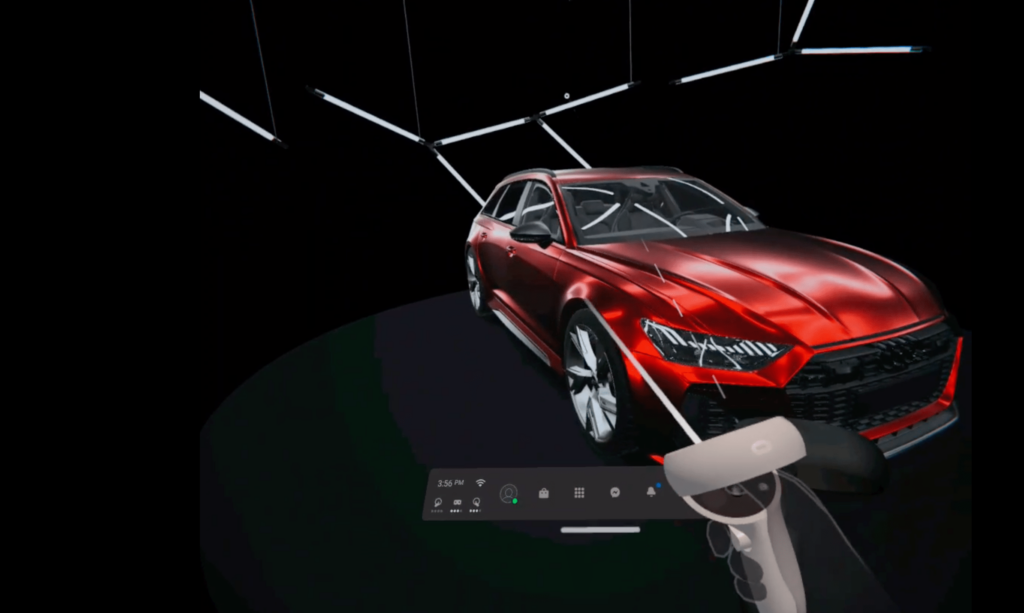
Hololight, a company specialized in immersive technologies, brings its XR streaming technology Hololight Stream to Oculus Quest 2. The software development kit enables the streaming of entire augmented and virtual reality (XR) applications in real-time to mobile XR devices. Hololight Stream addresses one of the major issues of standalone VR technology: limited computing power. By outsourcing the rendering process to an on-premises server or the cloud, 3D content that is only suited for high-performance processing can now be visualized on Oculus Quest 2. The streaming solution supports large data assets like graphics-intensive 3D objects, 3D CAD models, BIM, and Point Cloud.
“The success of Oculus Quest 2 shows how compelling VR can be when it is wireless and easy to use. It is time to unleash the full potential of VR, break the performance barriers of mobile devices, and bring VR content in unprecedented detail and complexity to Oculus Quest 2. Hololight Stream XR Streaming is just the technology to do that,” said Alexander Werlberger, CTO and Co-Founder of Hololight.
Hololight Stream can be integrated into any XR app developed with Unity in form of a simple plugin. This, for example, enables a virtual reality app to be executed on a remote computer such as a local server or the cloud. A corresponding client application runs on Oculus Quest 2 and receives the image stream. The connection between the client application and the server application enables real-time streaming of VR content, allowing better graphics, a significantly more intricate logic, and higher complexity.
The efficiency of streaming AR/VR/MR applications, in addition to handling arbitrarily large amounts of data, is due in part to the maximum simplification of handling many different end devices. Hololight Stream is compatible with the MRTK toolkit, connecting augmented and virtual reality by facilitating a cross-platform approach. New apps can be developed simpler without restrictions of individual end devices by just building a single server application. Hololight Stream streaming technology currently supports HoloLens 2 AR glasses, Android smartphones and tablets as well as the Oculus Quest 2 VR headset.
Laura Haase : Nov 17, 2026
XR trends 2026: spending is shifting to wearables, growth to services, and AI workloads to servers. What that means for enterprise XR deployment.
 Phillipp Landgraf : Nov 12, 2026
Smart glasses have no display, AR glasses do, and both now ship with AI. Here is what separates them and what each one can actually show you.
Phillipp Landgraf : Nov 9, 2026
Data sovereignty in defense: the frameworks that shape it, the CLOUD Act question, and the endpoint gap most XR programs miss.