
Hololight XR Streaming for SPECS
LOS ANGELES, SEPTEMBER 16, 2026
Hololight XR streaming comes to SPECS
On September 16 in LA, Snap co-founder and CEO Evan Spiegel gave the first in-depth look at Snap's SPECS augmented reality glasses.
Alongside it, Hololight announced interoperability between its enterprise XR streaming platform and SPECS.
Hololight and Snap have worked together since Spectacles, a previous generation of Snap's AR glasses, where customers run streamed applications today.
That work now extends to SPECS.
Read the Hololight and SPECS Q&A für streaming architecture, data security and supported devices.
“Hololight streams enterprise video, applications, tools, documents, and 3D models to SPECS, giving employees a secure, high-performance spatial workspace wherever work takes place.”
– Wayne Scullino, Director, Enterprise Sales and Partnerships at SPECS
SEE IT IN ACTION
Everything you work in, running side by side
A working day is not one application. In a Hololight session, a browser window, a document, a slide deck and a full-scale 3D model sit in the same space and are moved, resized and worked in together.
THE FULL SPECTRUM
From a design review to the rest of the working day
Enterprise XR has centered on high-end engineering applications and the sessions built around them.
Glasses that stay comfortable for hours widen what else belongs in that session.
The applications teams already work in
-
Autodesk VRED
-
KeyShot
-
NVIDIA Omniverse
-
Unreal Engine and Unity projects
-
Any other OpenXR-compatible application
-
Hololight Space for CAD review and collaboration
And the ordinary tools around them
-
Browser
-
Email
-
Documents
-
Presentations
Together these cover a working day rather than a single scheduled task, which is what makes a wearable device worth keeping on for enterprise and prosumer users alike.
TESTIMONIALS
Proven in cooperation with industry leading partners
Aerospace | Defense
"Hololight's XR streaming technology allows Lockheed Martin to run demanding AR applications while keeping all sensitive data inside its own infrastructure, independent of the headset being used. Large corporations like Lockheed Martin have the need for enterprise level AR headset capabilities that meet their security, IT, legal, and technology requirements to perform various AR use-cases, in which Specs is a potential solution that goes beyond consumer level devices."
— Marc O'Brien, Lockheed Martin Aeronautics
MEDTECH
"Hololight's streaming technology lets us bring complex 3D visualizations of patient anatomy and operating room setups directly onto lightweight AR glasses like Snap Spectacles, opening up new possibilities for training and pre-operative planning in healthcare."
— Lennart Claassen, Associate Director XR Solutions

education | exhibitions
"The greatest benefit of streaming with Hololight on Spectacles is the ability to deliver high quality AR content quickly and easily, without app downloads or device constraints, exactly what our large-scale exhibitions need."
— Scott Herman, CTO of AVARA Media
Engineering | Nuclear Energy
"At AtkinsRéalis our clients rely on us for practical ways for teams to interact with complex decommissioning information in the field while maintaining safety and reducing risk. Through our Nuclear XR programme, we have demonstrated how engineers can visualise full-scale assets, review future dismantling sequences and explore design options directly within the operational environment, without modifying source engineering data. Our collaboration with Hololight has enabled us to evaluate a new generation of lightweight mixed reality devices, combining streamed engineering content with excellent situational awareness and secure deployment and ease of use. What began as an exploratory trial quickly demonstrated that lightweight spatially aware XR can provide a compelling alternative to traditional immersive headsets for industrial use. As these technologies continue to mature, they have significant potential for supporting design reviews, planning and execution activities across nuclear sites and other complex, safety-critical environments."
— Marvin Johnson, Head of Extended Reality (XR), AtkinsRéalis Nuclear & Power EMEA
DEVICE SUPPORT
What runs on SPECS runs on the rest of your fleet
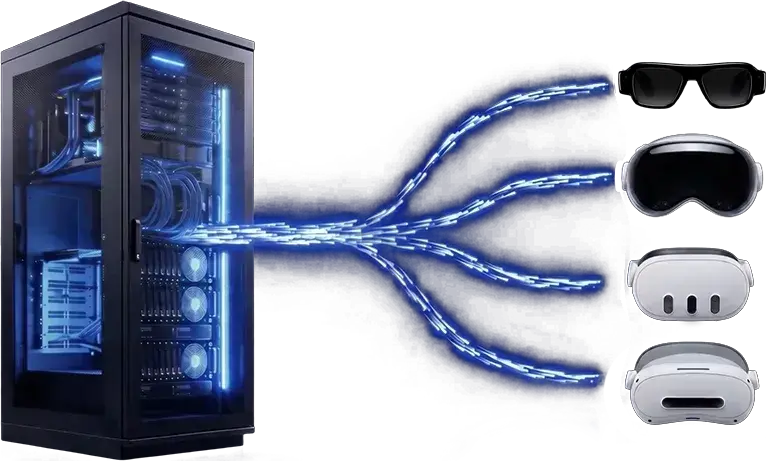
Your application runs and renders where it already lives.
Hololight sits between it and SPECS and streams nothing but encrypted pixels, so the glasses never carry the workload.
That architecture is also what lets the same application reach every other device your teams use.

One app, all your devices
The application you stream to SPECS also streams to Apple Vision Pro, iPad, Meta Quest, HTC Vive, PICO and Microsoft HoloLens 2. There is no second build and no porting, because nothing was ever built for a specific device in the first place. Teams can standardize on SPECS and still reach everyone who works on other hardware.
Your data stays where it already is
Models and files stay on your infrastructure for the whole session and only the rendered image travels, the same way company data stays on the PC rather than on the monitor. Nothing is left behind when the session ends, which is why the same setup works for shared devices, for teams across sites, and in regulated environments such as defense.
WHAT RUNS UNDERNEATH
Powered by enterprise-proven technology
The SPECS integration is built on the same technology foundation that BMW, Lockheed Martin, ENGIE Refrigeration and others already run in production.
Hololight's portfolio provides a complete environment for enterprise XR workflows across major industries.
The same environment that carries high-end engineering workflows now delivers the everyday tools around them.
XR Streaming
Pixel streaming built and owned by Hololight, independent of any third-party engine. Any OpenXR application streams from your server without a device-specific build.
Orchestration Platform
Your application catalog, user access and session oversight in one admin interface. Deploys on-premise, in the cloud or fully air-gapped.
3D CAD Viewer
Ready-to-use 3D viewer. Import CAD files directly, review full assemblies at 1:1 scale and run multi-user sessions across AR and VR devices at once.
PRESS RESOURCES
Hololight and SPECS: Questions and Answers
Common questions about Hololight's XR streaming on Snap's SPECS:
what the integration does, how the technology works, and what it means for enterprise use.
-
What is being announced?
Hololight announced interoperability between its enterprise XR streaming platform and SPECS, Snap's new augmented reality glasses, unveiled by Snap co-founder and CEO Evan Spiegel at a launch event in Los Angeles on September 16. The integration brings Hololight's streaming technology to SPECS, allowing the glasses to display complex, high-fidelity content without heavy onboard processing.
-
What does Hololight do?
Hololight builds the software layer that streams XR applications from a company's own servers or cloud to lightweight headsets and glasses. Its customers are engineers, designers and technicians in manufacturing, automotive, aerospace and defense, who use it to work with full-detail industrial models in AR and VR without preparing or simplifying the data first.
-
How does the streaming technology work?
Hololight streams pixels, not data. The application runs and renders on a workstation, on-premise server or in the cloud, including ray tracing and realistic lighting. The rendered images are encoded, encrypted and transmitted over Wi-Fi, 5G or LiFi, and the device decodes and displays them at up to 90fps with sub-50ms latency*. The technology is Hololight's own, developed in-house and optimized for NVIDIA RTX GPUs.
-
Why does this matter for SPECS?
Glasses built to be worn all day cannot carry the thermal and power budget of a high-end GPU. Moving the rendering off the device removes that constraint: SPECS stays light and comfortable, while the content it displays is limited by the server behind it rather than the hardware on the wearer's face. Scene alignment persists across sessions, so digital content stays anchored without recalibration each time.
-
What can people actually do with it on SPECS?
Two things at once. On the high-end side, the same engineering and design applications Hololight already streams, Autodesk VRED, KeyShot, NVIDIA Omniverse, Unreal, Unity and other OpenXR applications, become usable on glasses this light. On the everyday side, the same environment carries ordinary work tools: browser, email, documents, presentations. That combination is what Snap describes as a secure, high-performance spatial workspace.
-
What about data security?
This is central for enterprise use, and it is a direct consequence of the architecture. Because only rendered pixels reach the glasses, the underlying models, files and data never leave the customer's own infrastructure and are never stored or processed on the device. That matters wherever headsets are shared between people or locations, and it is why the approach works in regulated environments such as defense.
-
How does device-agnostic streaming support the broader ecosystem?
Hololight's streaming is hardware-agnostic by design, supporting Apple Vision Pro, iPad, Meta Quest, HTC Vive, PICO, and Microsoft HoloLens 2, alongside engine integrations for Autodesk VRED, KeyShot, NVIDIA Omniverse, Unreal, Unity, and more, and now extending to SPECS. The same underlying technology powers experiences across devices rather than locking content to one. It also decouples an organization's XR investment from any single headset: as new hardware arrives and older devices reach end of life, the applications keep running unchanged on the backend.
-
Who benefits most from this?
Primarily organizations that already have serious 3D and engineering workloads and have been held back by what a headset can carry. With SPECS, that extends further, to professionals who want one lightweight device for both a design review and the rest of their working day, rather than a dedicated headset they put on for twenty minutes at a time.
-
What does this mean for future generations of wearable AR hardware?
Shifting the computational load off the device gives hardware makers room to optimize for what wearers actually notice: weight, battery life, and a form factor closer to ordinary eyewear. As external rendering hardware improves, connected glasses can gain visual fidelity and capability without a hardware redesign.
-
What does this signal about where the industry is heading?
It reflects a shift away from bulky, single-purpose headsets toward glasses light enough to wear through a working day, and capable of handling real work while worn. Streaming has been able to deliver full-detail models to headsets for years. What changed is the hardware on the other end.
GET IN TOUCH
See what it looks like in your own environment
The fastest way to judge enterprise XR infrastructure is to point it at your actual data and workflows.
Get in touch and let's talk through your use case.
FAQ
Learn more about XR Streaming for Enterprises
-
Does Hololight support VR streaming?
Yes. Hololight's XR streaming technology supports VR streaming as well as AR streaming. For both, rendering happens on powerful backend hardware, so the headsets receive high-quality visuals without local processing.
-
Which XR streaming technology does Hololight use?
Hololight has developed theri own XR streaming technology. It is a powerful pixel streaming solution for augmented and virtual reality apps, optimized for the usage in industrial and enterprise environments. XR Applications can be streamed via Wifi, 5G or Lifi networks.
-
Why do I need to stream AR and VR applications?
Streaming removes the need for data preparation, avoids performance bottlenecks on headsets, supports more complex models, and ensures no sensitive data is stored on the device.
Typically, the performance of mobile AR/VR devices is limited, as is the size and complexity of industrial 3D content (e.g. machines, cars, airplanes). To allow users to see all the details of their 3D objects and avoid time-consuming data preparation, lower level of detail (LoD) or polygon reduction, Hololight provides unique integrated streaming technology. This way, XR applications run on more powerful local servers or in the cloud and pixelstream content in real time to the XR device. Because the data is stored on IT-managed servers, sensitive data stays protected, increasing data security.
AR/VR Streaming is also essential for future-proofing your enterprise XR strategy, because it decouples your applications from specific headset hardware. As new devices enter the market or existing ones reach end of life, your XR workflows continue to run unchanged on powerful backend systems.
-
How secure is XR streaming for enterprise use?
XR streaming keeps applications and data on your IT infrastructure, while only the rendered images are streamed to the AR/VR headset. This means sensitive data is not stored or processed on the end device itself.
This architecture is well suited for enterprise and industrial environments and can also be applied in highly regulated or sensitive contexts, such as the defense sector, where strict security requirements apply.
Learn more on our page about Secure XR Streaming in Defense.
-
How do I use Hololight's XR Streaming technology in my company?
Hololight Stream can be used in two ways:
Developers integrate the Hololight Stream SDK to make an AR or VR application streamable. The Hololight Stream SDK is free to explore with full functionality. To remove the watermark and use it commercially, reach out to our team.
End users can install Hololight Stream Runtime once to stream compatible OpenXR applications – such as Autodesk VRED, KeyShot, blender and many more – to a wide range of AR and VR devices. You can download a free trial for Hololight Stream Runtime here.