Spatial Computing Companies Shaping Enterprise XR
If you searched for spatial computing companies, you probably want to know who the players are and how to tell them apart. The label is slippery,...
Table of Contents
If you searched for spatial computing companies, you probably want to know who the players are and how to tell them apart.
The label is slippery, because it covers headset makers, chip and AI companies, streaming and orchestration providers, and application builders. The term spread after Apple called the Vision Pro a spatial computer,1 and it is now common across the industry.2 Each type of company shapes enterprise XR in a different way.
This guide maps the landscape by what companies actually do, so you can place each vendor in the right layer. That makes it easier to shortlist the right kind of partner. If you first need the underlying definition, our guide Spatial Computing, Explained covers it.
What you will learn:
No single company covers all of it. A working deployment usually pulls together several, because spatial computing is a stack of layers rather than one product. The table below shows those layers, from the device in your hands to the software your teams open.
The spatial computing landscape at a glance
| Layer | What these companies provide | What to look for |
|---|---|---|
| Device makers | AR and VR headsets and smart glasses that display the experience | Comfort, field of view, and whether you are locked to one device generation |
| Compute and AI | GPUs and rendering platforms that supply the processing power | Enough headroom for your largest models, plus a clear path to AI workloads |
| Streaming and orchestration | The layer that renders centrally and delivers to devices | Fidelity, latency, device support, and where your data is processed |
| Application and content | The XR software and 3D content your teams actually use | Fit to your workflow, and support for your file formats |
| Systems integration | Setup, deployment, and support across the other layers | Enterprise IT experience and a solid security track record |
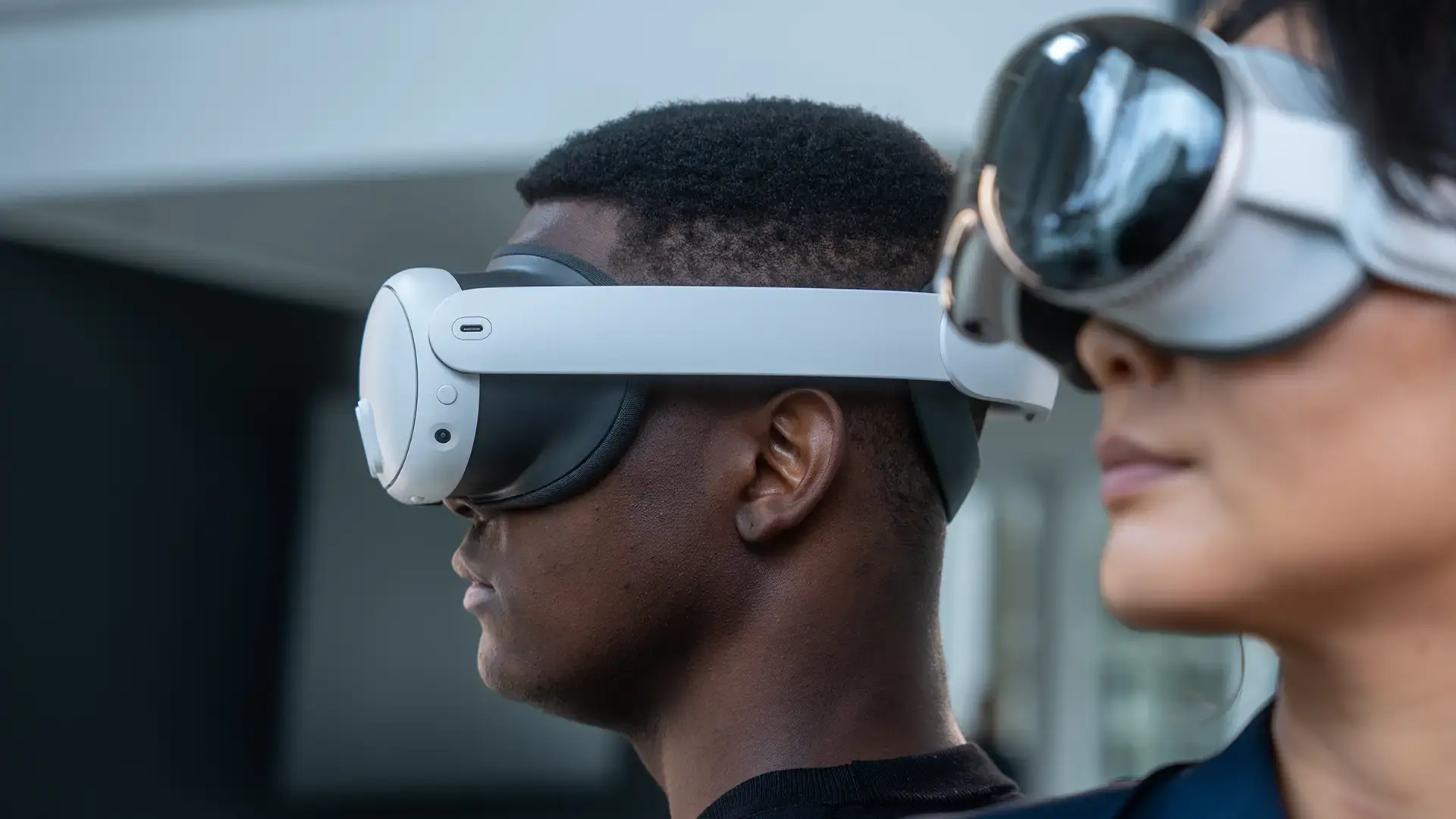
These companies build the hardware people wear, and the category moves quickly. Apple's Vision Pro brought the spatial computer idea to a wide audience, and many teams own one today. Snap, Meta and PICO keep pushing headsets and smart glasses forward, and a broader wave of smart glasses is on the way.
Those lighter devices carry less onboard compute, which makes streaming the practical way to run heavy models on them. Hololight's work with Snap shows that the streaming infrastructure built for full headsets carries over to lightweight glasses without changes.3
For enterprises, one point matters most: the headset should only be the display. If your workflow is tied to a single device or generation, every hardware refresh turns into a migration. A device-agnostic approach avoids that. Hololight's XR pixel streaming technology supports devices from makers like Apple, Meta, Snap, and PICO, so one workflow runs on every supported headset.
What to check when evaluating device makers:
For a closer look at the current device market, see our guide to AR headsets in 2026.
The device layer used to be a fragmentation problem. Every platform had its own proprietary interface, so an application written for one headset would not run on another without a rewrite. The major makers solved this by converging on OpenXR, a royalty-free open standard that lets one application run on any conformant device.
Before and after OpenXR
| Factor | Before OpenXR | With OpenXR |
|---|---|---|
| Portability | Each device needed its own proprietary code path | One API lets an application run on any conformant device |
| Hardware refresh | Could force a costly rewrite | Becomes a procurement choice, not a redevelopment project |
| Governance | Tied to one vendor's roadmap | Governed by a multi-vendor consortium by consensus |
OpenXR is governed by the Khronos Group, a non-profit consortium whose members steer the standard by consensus.4 Hololight is a member of the Khronos Group, contributing to how XR streaming works within the standard. Hololight's XR pixel streaming technology is designed to be conformant with OpenXR. The technology is based on a published Khronos Specification and is expected to pass the Khronos Conformance Process.
For the full picture, see our guides to what OpenXR is and OpenXR versus OpenVR.
High-fidelity 3D has to be rendered somewhere, and that is the job of the compute layer. The companies here supply the processing power, from workstation GPUs to cloud deployment. The best move is not buying a faster headset. It is running the rendering on infrastructure you control and sending only the result to the device.
NVIDIA is the best-known name in this layer, and it is where Hololight works most closely. Hololight's XR pixel streaming technology makes full use of your NVIDIA RTX hardware.5 Rendering runs on the server, and the headset only displays the result. Together, that combination runs full-fidelity models at enterprise scale.
The same infrastructure increasingly runs AI as well, and the two are converging fast. As real-time 3D, AI, and spatial computing come together, this layer becomes even more central to what enterprises can do.
What the compute and AI layer provides
| Component | Role |
|---|---|
| GPUs and servers | Render high-fidelity 3D at real-world scale, for example on NVIDIA RTX hardware |
| Rendering platforms | Prepare and manage 3D and digital twin data, for example NVIDIA Omniverse |
| AI workloads | Increasingly share the same infrastructure as XR |
This layer ties devices and compute together. The heavy rendering runs on a server or in the cloud, and only the finished pixels stream to the headset.
This is where Hololight sits. Its XR pixel streaming technology renders centrally and streams only pixels, so complex models can be visualized on any supported device. Sensitive data never leaves the server.
At the base sits Hololight Hub, the orchestration platform that hosts and manages your XR apps. Streaming runs on top of it, delivering any app on the platform to the headset. From this central management layer, IT can deploy applications and control who has access.
Streaming and orchestration usually come from different tools, but Hololight combines them into one. Hololight is the industry's leading XR streaming infrastructure for enterprise, the only complete proprietary pixel-streaming stack, purpose-built for cloud, on-premise and air-gapped deployment across defense, automotive, and manufacturing. That still needs a solid hardware base, meaning the XR devices and the servers that render. Even there, our partnerships help: MIFCOM offers ready-to-deploy workstations with Hololight Hub integration, and for large-scale, turn-key infrastructure there is NVIDIA Project Aurora.
The value of this layer shows up in real workflows, not in the technology on its own. A few examples from teams that use it:
How enterprises use this layer
| Company | What they do with it | Result |
|---|---|---|
| Genesis Design Studio | Run design reviews on full-detail models | Reviews cut from about 40 hours to 25, with up to three international clients in one session |
| BMW Group | Keep sensitive design data on their own infrastructure | 100 percent of sensitive design data kept in-house, and up to 12 months saved per development cycle |
| ENGIE Refrigeration | Overlay full-scale models onto real machines on site | Design changes made visible and discussable at 1:1 scale |
At the infrastructure level, Hololight's XR pixel streaming technology is part of the strategic collaboration behind Lockheed Martin Skunk Works' 5G Pixel Streaming Kit. The kit streams high-fidelity, real-time 3D visualization to edge devices for defense sustainment work.
The top layer is the software your teams actually open. Some comes from the big design and visualization vendors. Autodesk, one of the largest names in design software, builds tools like VRED, a fixture in automotive design, and Dassault Systèmes brings VR capabilities into its 3DEXPERIENCE platform.6 These are strong signals that the biggest design and engineering vendors see XR as core, and each becomes far more powerful once its output reaches any headset at full fidelity. Other tools are built in game engines like Unity and Unreal Engine, or written in-house by the teams that use them.
Whatever the source, this software has to reach the headset, and that is where the infrastructure layer connects. In-house apps built in Unity or Unreal become streamable with Hololight Stream SDK. Autodesk VRED streams into XR with a single click. And any OpenXR-compatible application can run through the same infrastructure, hosted and delivered from one place.
Who sits in this layer
| Company type | Examples | What they handle |
|---|---|---|
| Design and visualization software | Autodesk (VRED), Dassault Systèmes | CAD and design tools, several with their own XR |
| Game engines | Unity, Unreal Engine | Build XR apps that can be made streamable |
| ISVs and in-house teams | Ready-made or custom apps | Cover specific use cases, hosted and streamed |
Start by finding your gap. Because no company covers every layer, the useful question is which one you are missing. Three questions surface it quickly: device fit, rendering and delivery, and data control.
If your teams use mixed devices and heavy models, the streaming and orchestration layer is usually the priority. At enterprise scale, that infrastructure layer often decides success, because it keeps a deployment secure, manageable, and device-independent. Match the vendor type to the gap rather than to the loudest brand.
Match the vendor to your gap
| Your situation | Prioritize this layer | Ask the vendor |
|---|---|---|
| Mixed devices and frequent refreshes | Streaming and orchestration | How do you keep workflows device-agnostic? |
| Large or complex 3D models | Compute plus streaming | How do you render without a headset bottleneck? |
| Sensitive design or operational data | Streaming and orchestration | Where is my data processed and stored? |
| In-house developed software | Application and integration | How do you get our custom app into XR? |
They are the companies that build the hardware, compute, software, and infrastructure for computing in three-dimensional space. In practice they fall into a few layers: device makers, compute and AI, streaming and orchestration, and application and content.
The main types are device makers, compute and AI providers, streaming and orchestration providers, application and content developers, and systems integrators. Most enterprise deployments combine several of them.
In enterprise use, the two terms are often interchangeable. Spatial computing describes the broader idea of computing in three-dimensional space, while XR, AR, and VR describe the delivery modes and devices.
Look at device fit, at how 3D content is rendered and delivered, and at where your data is processed. It also helps to check whether the vendor locks you into one device generation, since hardware changes often.
Usually yes, because different companies cover different layers. You need capable hardware and the applications, but the infrastructure layer can come from one provider. Hololight delivers both the streaming and the orchestration in a single proprietary stack, so one vendor covers that layer. It stays future-proof, because you can add any OpenXR-compatible application or supported device without rebuilding your workflow.
Spatial computing is not one company or one product. It is a set of layers, each shaped by a different kind of company. For enterprises, the practical question is simple: which layer closes your gap? For teams with mixed devices and heavy 3D models, the connective streaming and orchestration layer is often what makes it all work.
Explore the XR Streaming Layer Behind Enterprise Spatial Computing
Prefer to talk it through with someone? Contact our team.
Last updated: August 3, 2026
Sources
If you searched for spatial computing companies, you probably want to know who the players are and how to tell them apart. The label is slippery,...
VR training has cleared the proof-of-concept phase. The outcome data is mature, enterprise spending is substantial, and adoption is no longer...
Engineering teams invest significant effort building accurate 3D models. Yet most reviews still happen on flat screens, in meeting rooms, with teams...